
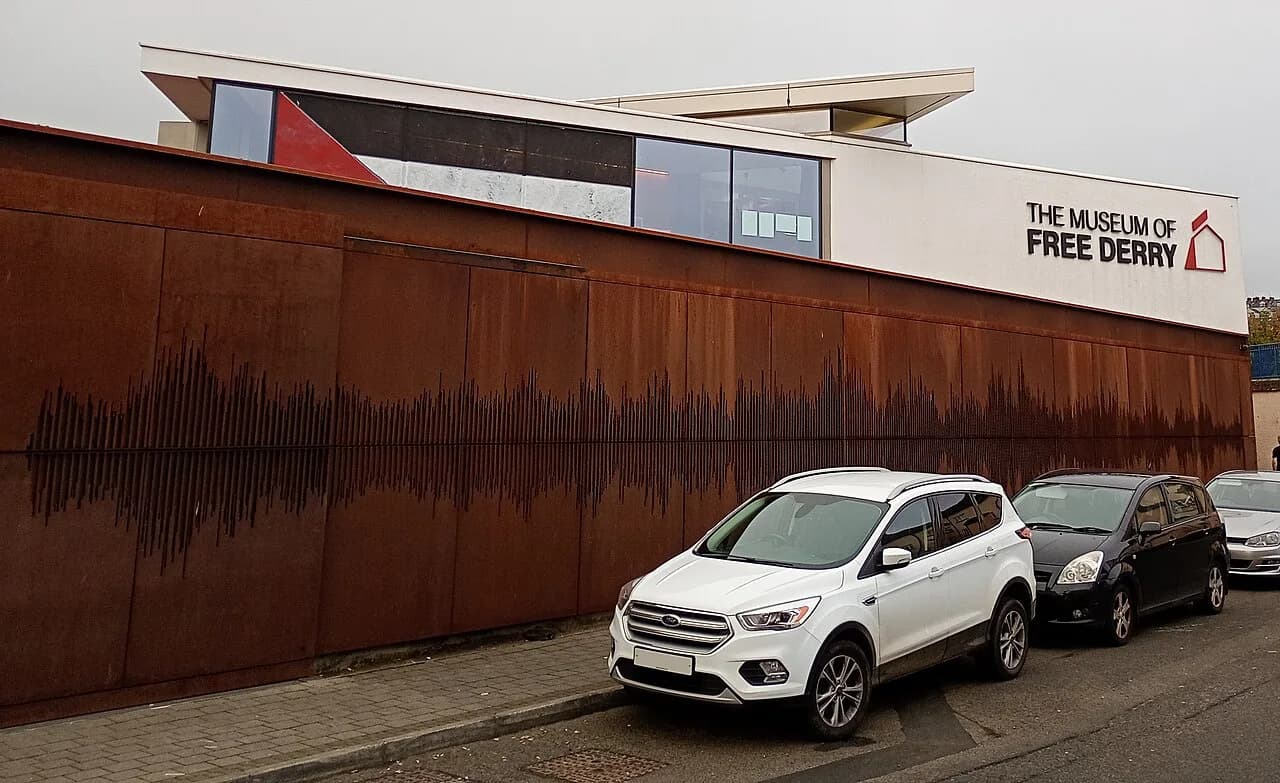
Museum of Free Derry: a visitor guide to the Bogside museum

The Museum of Free Derry is a focused civil rights museum in the Bogside, a few minutes' walk from the city centre and close to Free Derry Corner. It covers the years 1968 to 1972 rather than the whole history of the city, so it works best alongside a broader stop such as the Tower Museum rather than as a substitute for one; for the full set of options, see our guide to the museums in Derry.
Allow roughly an hour to ninety minutes if you read the panels and watch the multimedia material, and longer if you have a personal connection to the period. Tickets are charged, not free, and the museum sits in a purpose-built building in Glenfada Park off Rossville Street.
What the Museum of Free Derry is and where it sits in the Bogside
The museum occupies a modern purpose-built building in Glenfada Park, off Rossville Street in the Bogside, a short walk from the walled centre of Derry. VisitDerry describes it as a few minutes from the city centre, which makes it easy to combine with a walk along the walls or a stop at the Guildhall.
Its subject is the community that declared Free Derry in 1969 and the events that followed, told from the perspective of local residents. The museum's own site frames it as the people's story of government oppression, the civil rights struggle, the descent into conflict, Free Derry and Bloody Sunday.
That tight geographic and chronological focus is the point. This is not a general city museum, so if you want Derry's wider story from the Plantation to the shipyards, pair it with another collection and use this one for the civil rights era. For that wider picture, our round-up of the museums in Derry covers the Tower Museum and the city's other collections.
The story it tells: civil rights, Free Derry, Internment and Bloody Sunday
The displays run from the Northern Ireland civil rights movement through to Operation Motorman in 1972. VisitDerry lists the themes as the civil rights era, the Battle of the Bogside, Internment, Bloody Sunday and Operation Motorman, all set within the period known as Free Derry.
The name Free Derry comes from the barricaded area the Bogside community declared self-governing in 1969, and the museum takes that as its starting point. Expect first-hand testimony, photographs and archive material rather than reconstructed rooms or costume displays.
The tone is serious throughout. Bloody Sunday, when British soldiers shot dead thirteen civil rights marchers in the Bogside in 1972, is treated at length, so the museum suits readers who want the detail rather than a light overview.
How the museum began: the Bloody Sunday Trust and the Glenfada Park building
The Bloody Sunday Trust established the museum in 2006, and VisitDerry notes that it later moved into its current purpose-built home. In 2018 Tourism Northern Ireland gave it the award for Authentic Experience of the Year, which reflects how closely the collection is tied to the people who donated its contents.
Much of what you see was given by local residents rather than gathered by curators, and the museum describes itself as a public space where Free Derry is explored in both historic and contemporary terms. That gives the collection a personal, unsentimental quality that many civic museums lack.
What to see inside: multimedia displays and a 25,000-item archive
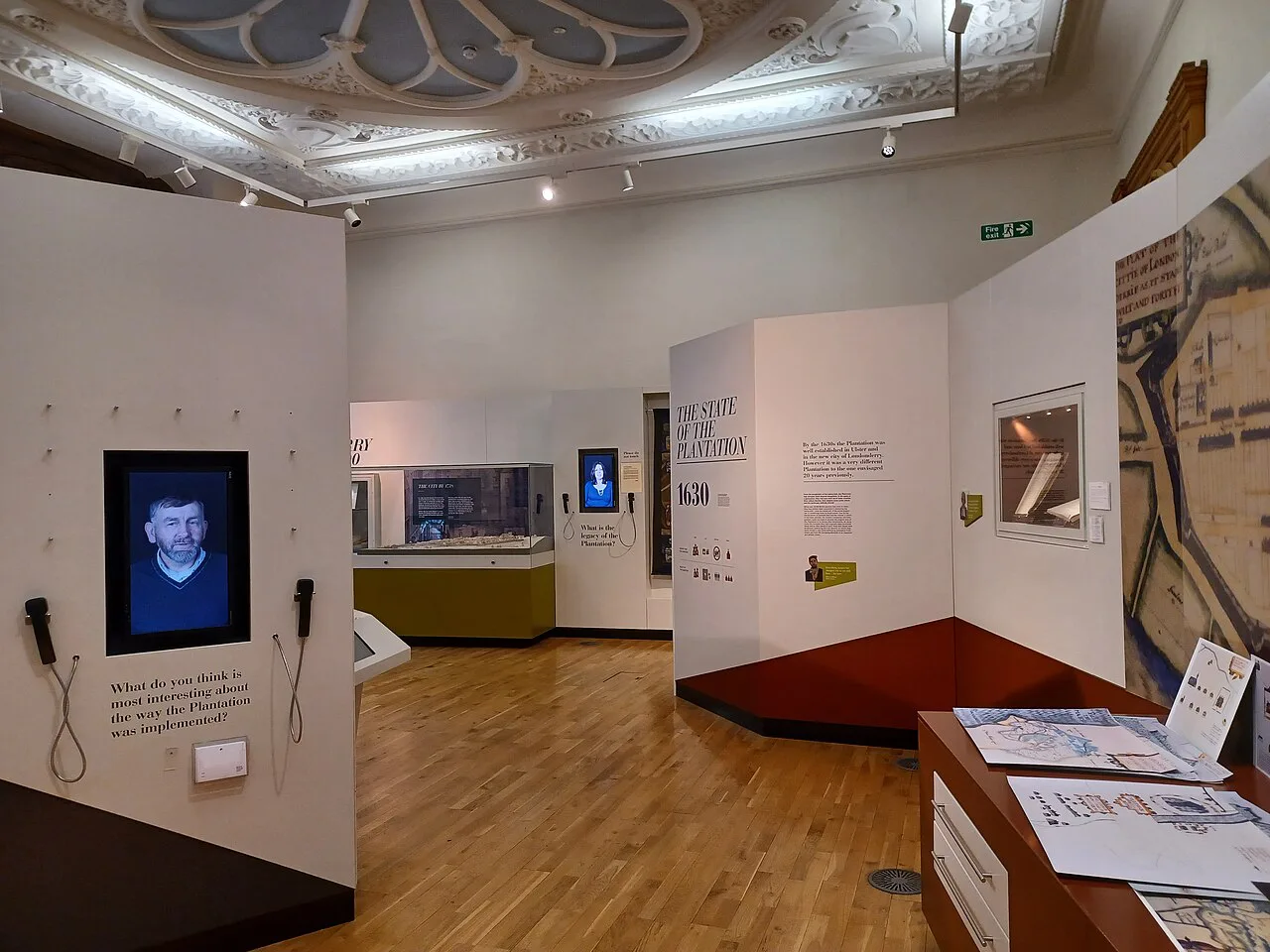
The museum is built around multimedia displays, with film, audio and photographic material carrying most of the narrative. VisitDerry records an archive of more than 25,000 individual items relating to the 1968 to 1972 period, most of it donated by local people.
Only part of that archive can be on show at once, so treat the galleries as an introduction rather than a complete record. If you are researching the period, ask at the desk about access to the archive before you travel.
Visitors on TripAdvisor consistently describe it as a small but absorbing museum, and its scale means you can see everything in one sitting without rushing.
Tickets and prices: adult, student, retired, unwaged and resident rates
Admission is charged, and VisitDerry publishes four ticket tiers: adult, student, retired, disabled or unwaged, and a reduced rate for residents, carers and Friends of the Bloody Sunday Trust. Check the current prices on the booking page when you plan, because these are published rates rather than guaranteed forever.
Tickets can be bought through the VisitDerry page, so there is no need to turn up without one if you want certainty on a busy weekend. Bring proof of status such as a student card or ID if you are claiming a concessionary rate.

Opening hours: weekday seasons, flat weekend hours and last admission
Weekday hours change with the season. VisitDerry lists 9:30 to 17:00 from 5 January to 28 February, 9:30 to 18:00 from 1 March to 31 October, and 9:30 to 17:00 again from 1 November to 21 December.
Weekends run to a single pattern all year, 10:00 to 16:00 on Saturday and Sunday. Last admission is one hour before closing, so the practical cut-off is 16:00 on weekdays in winter, 17:00 in summer and 15:00 at weekends.
Bank holidays and the days between Christmas and New Year are not covered by that pattern, and no source here sets out holiday variations. Phone the museum on (028) 7136 0880 before making a special trip at those times.
How long to allow and how to pace a visit
Budget around sixty to ninety minutes for the galleries if you watch the films and read the interpretation. The museum is compact, so two hours is generous unless you are researching a particular event or person.
The subject matter is heavy, and many visitors find Bloody Sunday and Internment difficult rather than entertaining. If you are travelling with someone who finds conflict history upsetting, put the museum earlier in the day and follow it with a walk on the walls or a stop for tea rather than another dark exhibition. If a lighter stop would suit your group better, our guide to the museums in Derry lists the city's gentler collections to pair with this one.
Photography rules and group bookings are worth confirming by phone before you arrive, since the museum does not set them out on the booking page.
Getting there: from the city centre to Glenfada Park off Rossville Street
From the city centre, walk through the Bogside to Rossville Street and turn into Glenfada Park, where the museum stands. VisitDerry puts the walk at a few minutes from the centre of Derry, which means most visitors can leave the car behind and reach it on foot from the Diamond or the Guildhall Square.
On foot from the Guildhall area, head up Bishop Street and down into the Bogside, passing the murals on Rossville Street. Drivers can park in the city centre and walk in, though parking charges around the centre are not set out here, so check local signage when you arrive.
The museum gives its contact details on the VisitDerry page, including phone and email, for anyone who needs to ask about access before a visit.

Nearby: Free Derry Corner and the Bogside murals
Free Derry Corner, the gable end that marked the entrance to the no-go area, stands a short distance from the museum and is free to look at. The surrounding streets carry the Bogside murals, so a visit slots naturally into a walk that takes in the corner and the surrounding estate.
St Eugene's Cathedral sits uphill from the Bogside and is worth a look for its nineteenth-century Gothic Revival interior. Alternatively, return to the walled centre for the Guildhall or the Tower Museum if you want the city's wider history after the civil rights story.
Wider choices across the city, including cathedrals, walls and museums, are gathered in our guide to Derry attractions so you can plan a route on foot.
Booking, accessibility and groups
Book ahead through the VisitDerry pass page if you want a set time and a guaranteed ticket, especially at weekends when the museum closes earlier. The page also lists the contact phone number for questions about access before you travel.
For step-free access, wheelchair availability and group rates, ask the museum directly rather than assuming standard provision. Its own site and the booking page do not set these out, so a quick call is the reliable route.
Who the museum suits and who might find it heavy going
The museum suits adults and older teenagers who want a serious account of the civil rights era, and readers with a family connection to the Bogside will find it especially direct. It rewards time spent with the films and testimony rather than a brisk lap of the displays.
Young children will find it difficult, and anyone expecting a light city history museum would do better at the Tower Museum or the Foyle Valley Railway Museum, one of the gentler options in our guide to the museums in Derry. There is no way around the grim subject matter here, and the museum does not present it as a family attraction.
Plan a Visit
The Museum of Free Derry is best booked online, visited in the morning while you are fresh, and followed by the Bogside murals and Free Derry Corner on foot. Allow around ninety minutes and leave time for the walk from the city centre.
If you want a fuller picture of the city, combine it with the walls, the Guildhall and other museums in Derry, and check the opening hours page before setting out on a special trip.
Explore more Derry guides
Frequently Asked Questions
Is the Museum of Free Derry worth visiting?
If you want a clear account of the civil rights era and Bloody Sunday, it is the most focused museum in Derry for that subject. It is small, charged and serious, so it suits readers who want the detail rather than a light overview.
How long does the Museum of Free Derry take?
Allow around sixty to ninety minutes for the multimedia displays and archive material. If you watch every film and read the interpretation closely, give it two hours.
Why is the area called Free Derry?
The name dates from 1969, when the Bogside community barricaded the area and declared it self-governing. The museum takes the period 1968 to 1972 as its subject, ending with Operation Motorman.
How much does the Museum of Free Derry cost?
Admission is charged, with adult, student, retired, disabled or unwaged, and resident, carer or Friends rates. Check the VisitDerry booking page for current prices before you travel.
What are the Museum of Free Derry opening hours?
Weekday hours change with the season, opening 9:30 to 17:00 in winter and 9:30 to 18:00 from March to October. Weekends run 10:00 to 16:00, and last admission is one hour before closing.
Is the Museum of Free Derry suitable for children?
It covers Bloody Sunday and Internment in detail, which is difficult material for young children. Older teenagers studying the period usually get the most out of it.
Do you need to book the Museum of Free Derry in advance?
Booking ahead is sensible at weekends, when the museum closes at 16:00. You can book through the VisitDerry pass page, and it is worth doing if your trip is short.
What is near the Museum of Free Derry?
Free Derry Corner and the Bogside murals are a short walk away, and the city centre with the walls, Guildhall and Tower Museum is a few minutes on foot.