
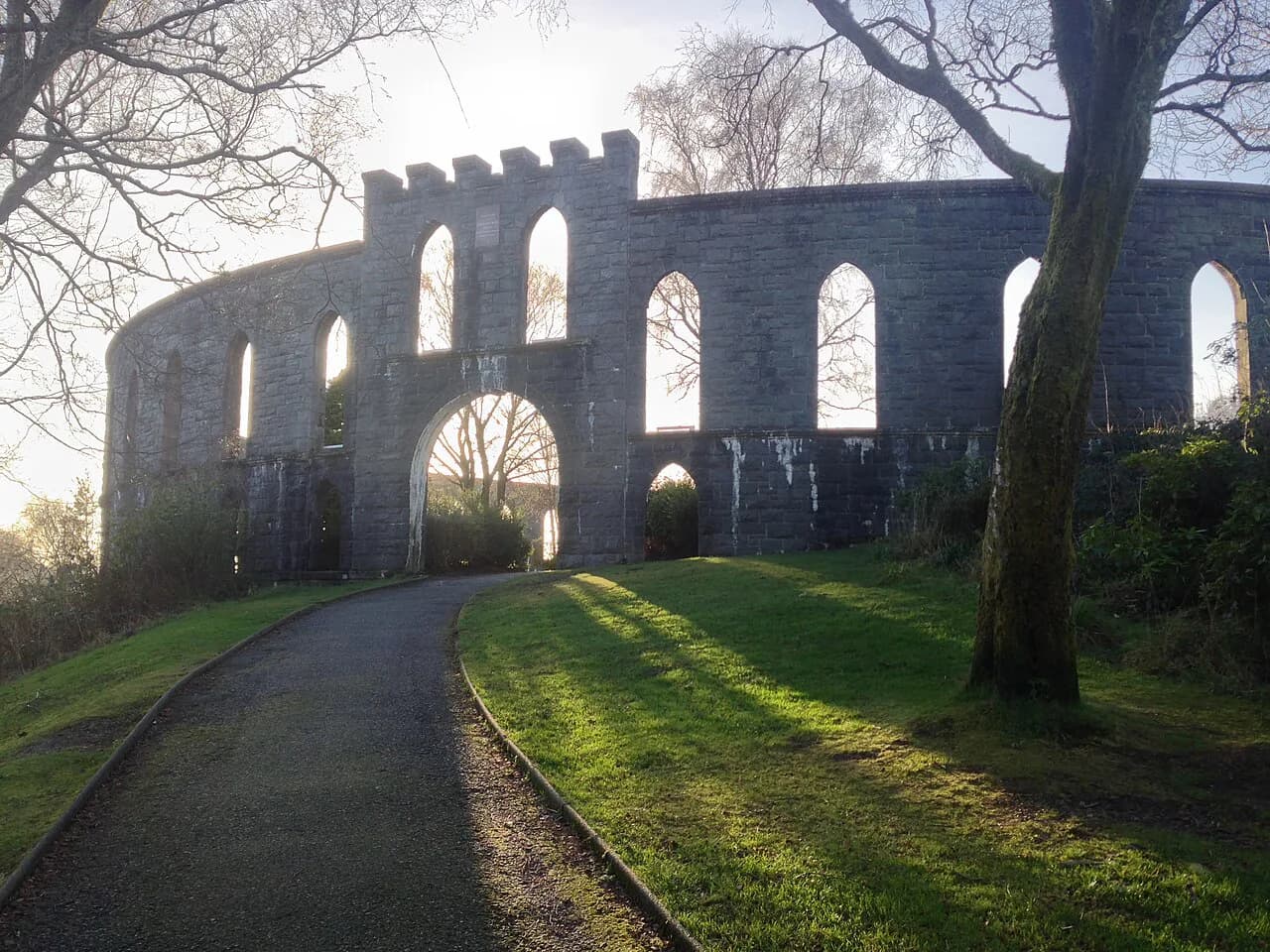
McCaig's Tower, Oban: a Free Folly Above the Bay

McCaig's Tower is a free, open-access granite folly on Battery Hill above Oban, and the short answer for most visitors is that you can walk up at any hour, pay nothing and be back in town within an hour. There is no gate, no ticket desk and no roof: what you see is the unfinished outer shell of a Victorian monument, with a garden inside and a viewing platform on its west side.
The climb is the trade-off. The path from the town centre is steep, and the hillside roads are narrow if you drive, so this suits walkers and rewards anyone who treats it as a viewpoint rather than a museum. It sits within easy reach of the rest of Oban, which makes it a sensible first or last stop of the day.
Where McCaig's Tower stands
The tower occupies the summit of Battery Hill above Oban Bay, in Argyll and Bute on Scotland's west coast. Its address is Duncraggan Road, Oban PA34 5DP, and it stands roughly 60 to 70 metres above the harbour, which is what gives the site its view.
Oban itself is a small ferry port known as the Gateway to the Isles, with sailings to Mull, Iona and Kerrera leaving from the harbour. That geography explains why the tower's view matters more than its interior: from the hill you look straight out over the bay and the islands beyond. For a wider set of town options, the guide to Oban Attractions covers the distillery, castles and museums in the same compact centre.
A short history: John Stuart McCaig and the 1897–1902 build
John Stuart McCaig was a native of the Isle of Lismore who became a successful banker with the North of Scotland Bank. He was 72 when, in 1895, he commissioned work on the structure that took his name; building continued until his death in 1902, and by then it had cost him some £5,000, a figure from the time of construction rather than today's money.
One aim was philanthropic: providing work for stonemasons during idle winter months, which is why progress came mainly in winter. The tower also served as a family memorial, and the inscription above the entrance records McCaig as art critic, philosophical essayist and banker. After his death, a bequest intended to fund completion was challenged successfully in court by relatives, so the shell you see is what stood when he died.
The stone is Bonawe granite, extracted from quarries on Loch Etive, and the wall runs for about 200 metres around the hilltop. Its height varies around the circumference to follow the contours of the ground, which is why the ring looks uneven rather than engineered to one level.
Why it looks like the Colosseum
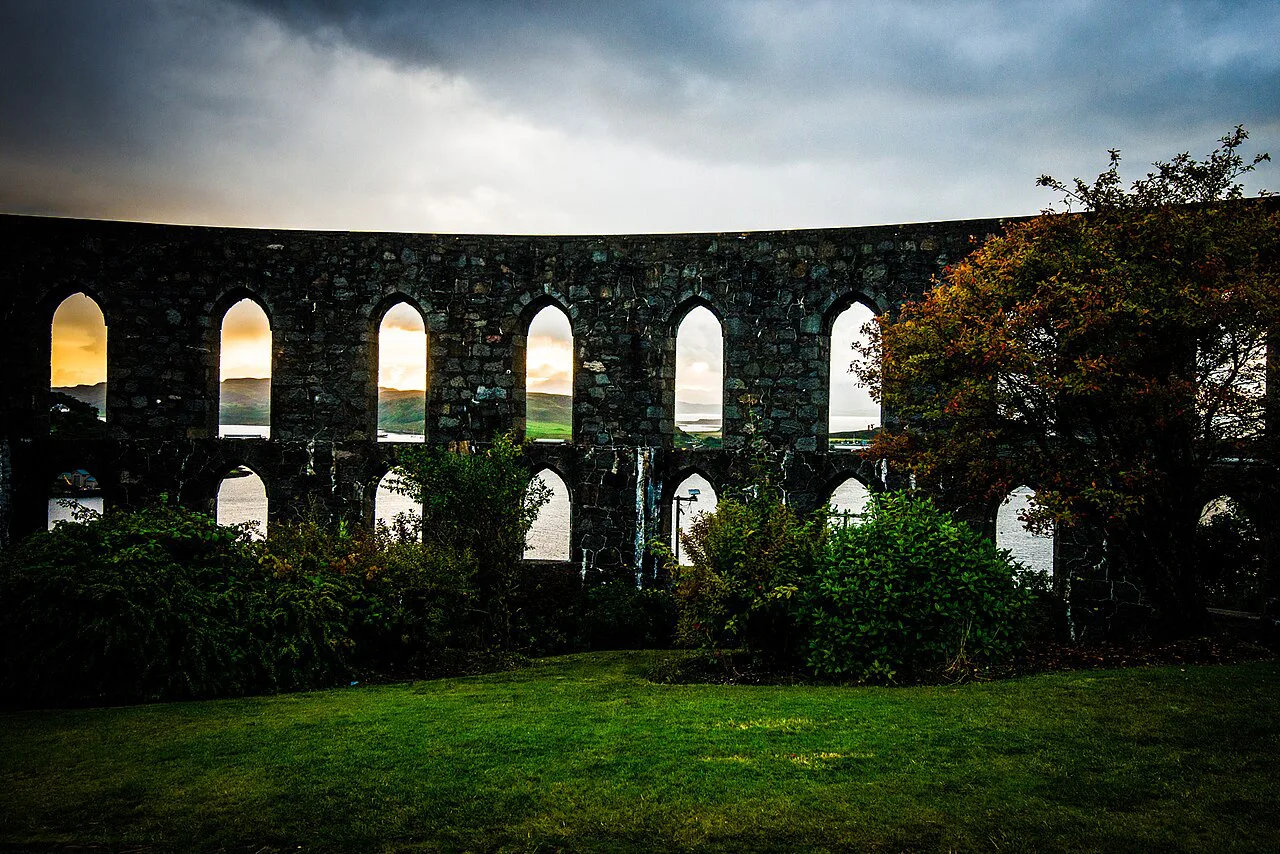
The resemblance is structural, not marketing. The wall is pierced by two rings of lancet arched openings, one above the other, and the curved outline against the sky reads immediately as a Roman amphitheatre. That is why locals and visitors call it the Colosseum of Oban, though it has always been a folly rather than a working arena.
Rome's Colosseum was completed around AD 80 as a working arena with tiered seating for tens of thousands; McCaig's Tower is a Victorian shell with an open centre and no seating at all. The shared feature is the ring of arches, and the difference is what those arches frame: Oban Bay, Kerrera, Mull and the Firth of Lorn instead of a crowd.
What to see on site
Walk the outside of the shell first to read the arches and the varying wall height, then go through the gateway on the south-east side into the centre. The interior holds a garden and seating, and it is a calm place to sit once you have done the circuit. Information plaques around the site set out the history.
The specific spot for the best view is not simply the top of the hill: a much smaller doorway on the west side leads to a concrete viewing platform looking over Oban, Kerrera, Mull and the Firth of Lorn. Seek that doorway out rather than stopping at the first opening in the wall. The garden also spills over on the east side and continues down the hillside, which gives a second angle on the structure.
Allow time to read the plaques and photograph the arches at different angles, but do not expect displays, café facilities or an enclosed exhibition space inside. This is an outdoor monument whose appeal is architecture plus outlook.
The view: Oban, Kerrera, Mull and the Firth of Lorn
From the platform the panorama takes in the town below, the Isle of Mull, Kerrera and Lismore, and the water of the Firth of Lorn. Because the tower stands well above the harbour, the view is unobstructed in the main directions and works in almost any weather that gives visibility.
Morning and late afternoon give the best light for photographs, and sunrise or sunset is the strongest window if you are prepared to time the climb around it. The hilltop is exposed, so wind and rain arrive faster than they do in town. If the weather closes in, the town centre and Oban Harbour are a short walk back downhill.
Tickets and opening
Admission is free and the hill is open at all hours, with no gate or ticket to negotiate. The site is accessible year-round, and spring through early autumn tends to give the mildest weather and longest daylight for the climb.
The tower is a Category B listed building, and the hilltop is looked after by Argyll and Bute Council in partnership with local heritage organisations. Access is self-guided; there is no on-site ticket office, so any guided tour would have to be arranged separately through operators working in the town.

Walking up from town
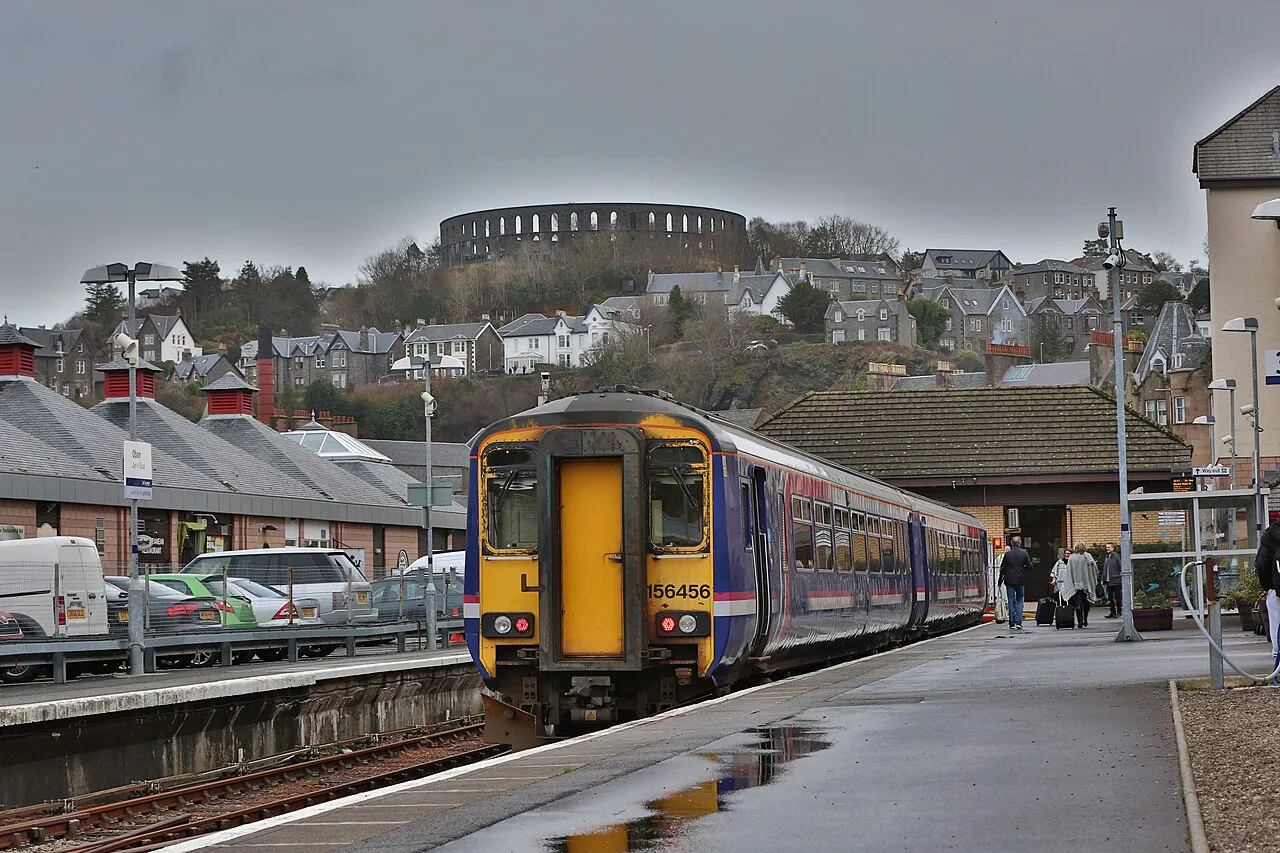
The walk from Oban town centre takes roughly 15 to 20 minutes, following signs up Battery Hill; from Oban railway station it is about 20 minutes. Wear shoes with grip, because the path is steep and in places stepped, and carry a waterproof layer for the exposed summit.
There is no single official trailhead: a handful of lanes, stepped paths and roads climb the hill from different sides of town, so pick the route nearest your starting point and accept that the last stretch is the steepest. The reward is that the whole climb is short enough to fit between other stops.
Arriving by car
You can drive up, but the road is steep and narrow and passes through a residential area. There is limited on-street parking nearby and only a handful of spaces at the top, with a parking area reached by following signs through the hillside roads to a point just behind the tower.
Where you leave the car decides how steep the walk up will be, since the residential streets climb at different gradients. On busy summer days the few spaces go quickly, so the practical choice is to park in town and walk rather than circle the hill.
Arriving by train, bus or ferry
Oban is reachable by train and bus from Glasgow and other Scottish cities, and local buses serve the town centre. From the station, exit and follow the signs for McCaig's Tower; the route climbs steadily rather than gently.
Arriving by ferry puts you on the seafront with the tower visible above the town, which makes the direction obvious. If you are combining the tower with a distillery tour, note that Oban Distillery sits in the town centre near the harbour, so the natural order is distillery first and the hill afterwards.
How long to allow
Plan about one to two hours for the full visit: the climb, a circuit of the exterior, time in the central garden and a stop at the west viewing platform. If you only want the view, a brisk up-and-down with ten minutes at the top is enough.
Because entry is free and there is no fixed closing time, the visit slots easily into a day built around ferry timetables or museum opening hours elsewhere in town. Build in a buffer if you are catching a sailing, as the descent is quicker than the climb but still takes time.

When to go
April to October gives the best conditions, with the warmest weather and longest days in June to August, when the site can also be busiest. Autumn brings cooler air and colour, while winter means short days and dramatic scenery that demand warm layers.
Scottish weather changes quickly on an exposed hilltop, so check the forecast before setting out and accept that a clear morning can turn grey by the time you reach the top. The walk down is always available, and the town centre offers indoor alternatives if the rain sets in.
Practical points
Expect steps, uneven ground and a wind-exposed summit, with no facilities on site; take water and use the town centre for toilets and cafés before or after. Sturdy footwear matters more than any other preparation, because the path surfaces are rough and steep.
The site is a listed building and a public garden, so visitors are asked to respect the structure and its surroundings. There are information plaques on site, but no visitor centre, so read up before you climb if you want the history in context.
Nearby: Pulpit Hill and the town below
Pulpit Hill, on the south side of the bay, is Oban's other superb viewpoint and offers a genuine alternative if you want a second outlook without repeating the same scene. From Pulpit Hill you can also see McCaig's Tower across the bay, which helps you judge the town's shape. If you enjoy pairing viewpoints with castle ruins, the things to do in Stirling cover a hilltop castle and old town walks.
Back down in town, Dunollie Castle Oban sits on the coast north of the centre and pairs well with a morning on the hill; it is a separate site with its own arrangements, so check its details before you go.
Further afield, Dunstaffnage Castle is a Historic Environment Scotland site outside town, and the Oban War and Peace Museum on the waterfront covers the town's wartime history. Either works as an indoor fallback if the hilltop weather turns.
What McCaig planned but never built
You will hear that McCaig intended to roof the tower and use the interior for an art gallery and museum, and that he planned statues of himself and his family in the lancet openings. Treat both as accounts rather than settled fact. The walls are relatively thin and the interior ground was never levelled, which argues against a large enclosed building.
A more convincing suggestion is a central tower within the encircling wall, by some accounts up to 100 feet high, which might have housed a museum and gallery at the cost of the Colosseum resemblance. Filling close to a hundred lancets with family statues would also have required a large commission, so the openings may never have been meant for them.
Plan Your Visit
McCaig's Tower is the honest trade-off of an Oban city break: free, open at any hour and quick to visit, but reached by a steep climb or a narrow residential road with a handful of spaces. Go for the structure and the view from the west platform rather than for a museum experience, and allow one to two hours including the ascent.
Check the weather before you set out, wear shoes with grip and build the tower into a day that also uses the town centre below. For the rest of the town's sights, from the distillery to the museums and castles, the Oban Attractions guide sets out what each one costs and how long it takes.
Frequently Asked Questions
What was McCaig's Tower built for?
John Stuart McCaig commissioned it in 1895 as a family memorial and to provide winter work for local stonemasons. Building ran between 1897 and 1902, and the structure was left as it stood when McCaig died that year.
Is McCaig's Tower free to visit?
Yes. Admission is free and the hill is open at all hours, with no gate or ticket desk on site. There are no facilities, so plan around the town centre for toilets and refreshments.
Can you drive up to McCaig's Tower?
You can drive up, but the road is steep and narrow through a residential area, with limited on-street parking and only a handful of spaces at the top. On busy days, parking in town and walking is the simpler choice.
How do I walk to McCaig's Tower?
From Oban town centre, follow the signs up Battery Hill; the climb takes roughly 15 to 20 minutes. From Oban railway station the walk is about 20 minutes. The path is steep and partly stepped, so wear shoes with grip.
How long does a visit take?
Allow one to two hours for the climb, a circuit of the exterior, time in the central garden and a stop at the west viewing platform. A quick view-only visit takes considerably less.
Why is McCaig's Tower called the Colosseum of Oban?
The wall has two rings of lancet arched openings and a curved outline that echoes a Roman amphitheatre. Unlike Rome's Colosseum, it was never a working arena: it is a Victorian folly with an open centre and no seating.
Was McCaig's Tower ever finished?
No. Work stopped at McCaig's death in 1902, and a bequest intended to fund completion was successfully challenged in court by relatives. What remains is the unfinished outer shell with a garden inside.
Where is the best view from McCaig's Tower?
A small doorway on the west side leads to a concrete viewing platform with views over Oban, Kerrera, Mull and the Firth of Lorn. Seek it out rather than stopping at the first opening in the wall.