
Nottingham Council House: A Visitor's Guide to the Old Market Square Landmark

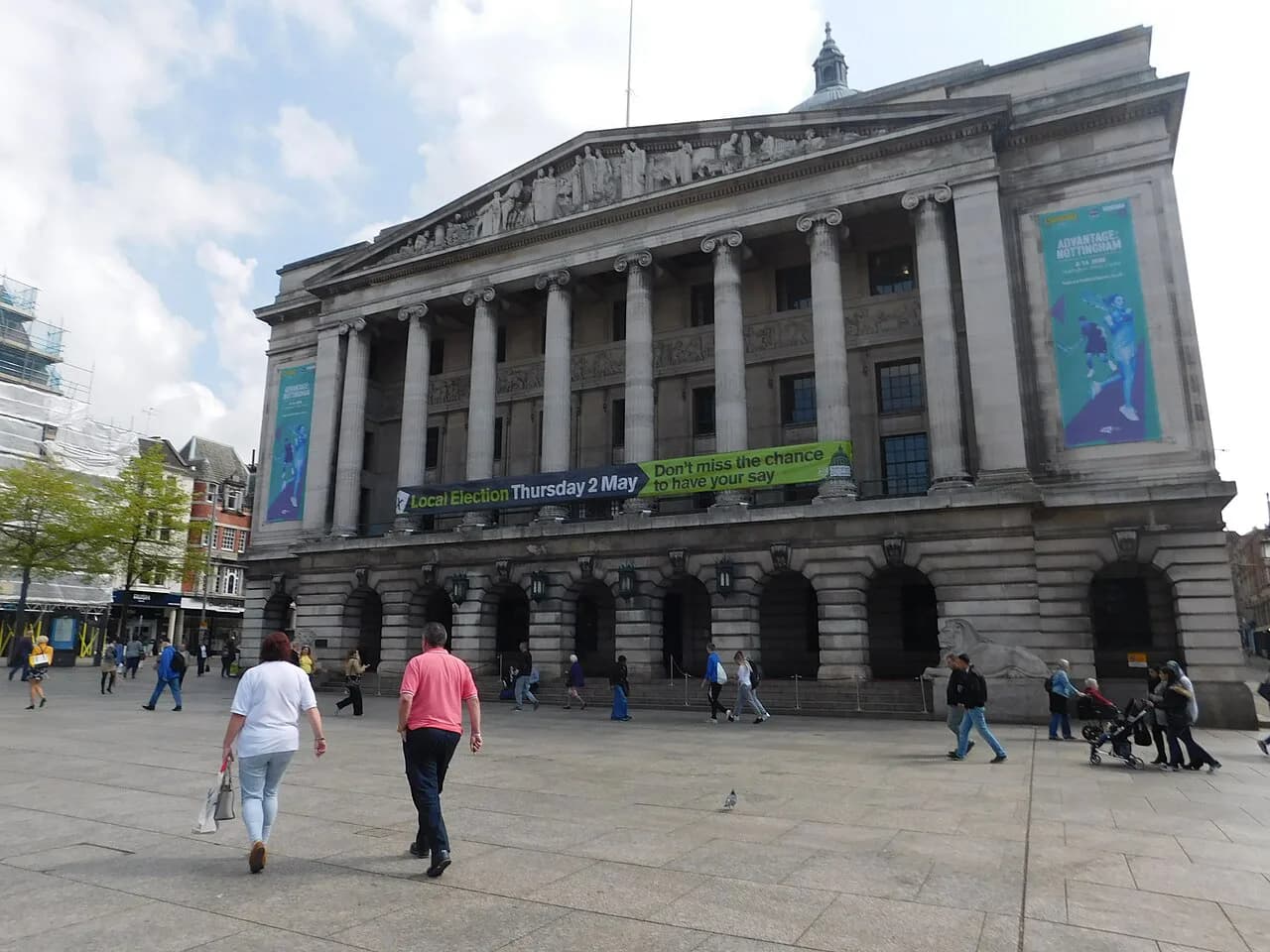
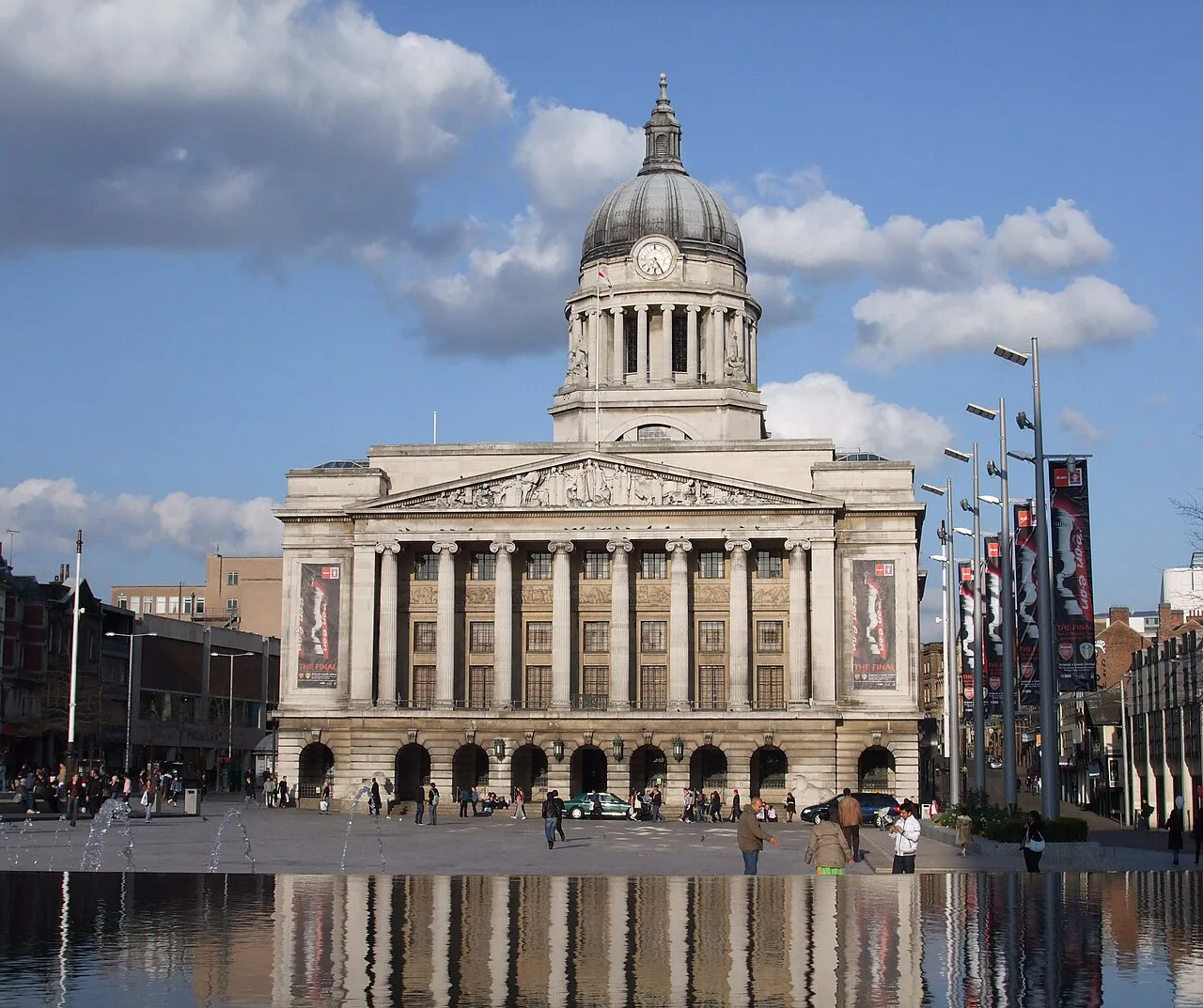
Nottingham Council House is the city's civic building, standing squarely on Old Market Square and topped by a dome that rises 200 feet above the streets. Most visits are made from the square itself, where the Portland stone façade, the columns and the clock face do the work. It is a working civic building, so plan on it as a short, deliberate stop rather than a half-day attraction.
Where the Council House sits
The building anchors Old Market Square, the wide open space at the heart of the city centre where tram lines, buses and shoppers converge. Its ground floor holds the Exchange, an arcade of shops originally designed to help fund the construction of the Council House during the Great Depression. That makes the site easy to fold into a shopping or tram-based day: you pass through, look up and keep moving.
A short history of the building
The Council House was built between 1927 and 1929 to replace the old Nottingham Exchange, to a Neo-Baroque design by architect Thomas Cecil Howitt. The foundation stone was laid by Alderman Herbert Bowles on 17 March 1927, and the Prince of Wales opened the building on 22 May 1929. The same account puts the original cost at £502,876, a historical figure from the late 1920s rather than anything you will pay today.
Do not confuse this civic building with council housing. Nottingham City Council Housing Services manages the city's council homes and operates separately from the Council House, so anyone looking for a home should start with its housing pages rather than turning up at the square.
The exterior: Portland stone and sculpted figures
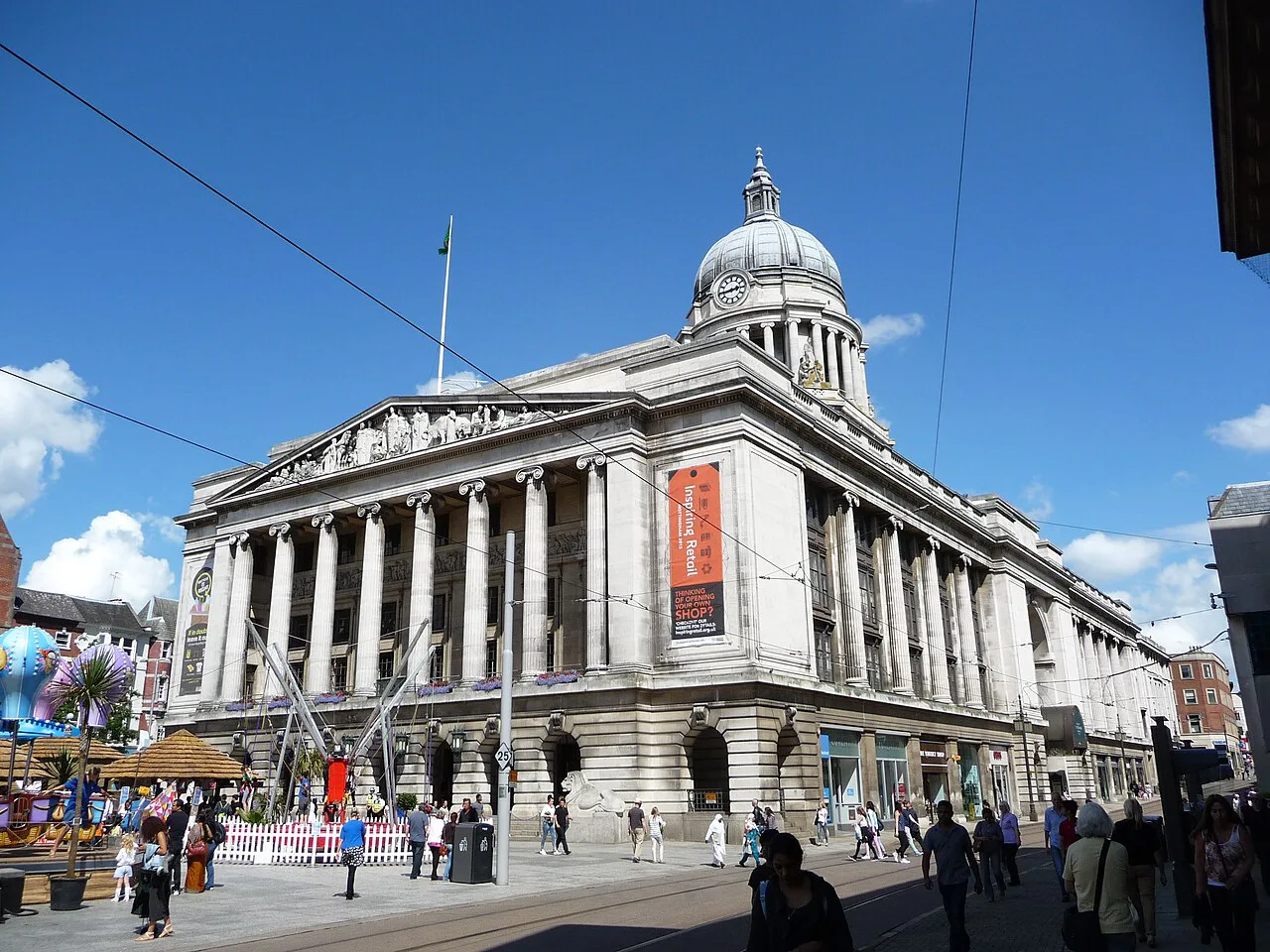
The façade is cut from Portland stone, from the same quarry that supplied St Paul's Cathedral. Eight massive columns carry 21 figures carved by Joseph Else, each representing an activity of the council, so a slow walk along the front turns into a short lesson in civic self-image. Give the front five or ten minutes and look up at the figures before you move on.
The dome and the Little John bell
The dome rises 200 feet above the city and shelters Little John, a bell cast by John Taylor & Co. that weighs more than ten tonnes and is described as the deepest-toned clock bell in the UK. The clock beneath the cupola has a 13-foot pendulum, with a dial standing 150 feet above ground and Westminster Chimes ringing across the square. You cannot miss the dome from anywhere in the square; the clock face is best read from the middle of the open space.

Inside the Council House
The entrance hall is lined with Italian marble, with the City Arms inlaid as a mosaic in the centre of the floor. Above it, the Ballroom has gilt columns and a decorated ceiling, with French windows opening onto a balcony over Old Market Square. Painted murals beneath the dome, created by local artist Noel Denholm Davis, show scenes from Nottingham's history, including the Danes capturing Nottingham and tales of Robin Hood.
These are civic rooms rather than museum galleries, so do not count on walking into the Ballroom or under the dome on any given day. Build your visit around the square and the exterior, and treat any interior access as a bonus. Nottingham City Council publishes what is open and when, so check the council's listings before travelling if the interior matters to you.
How the Exchange Arcade fits in
The ground-floor Exchange was designed as a shopping arcade to help pay for the building, and it has kept that role. It is a route through the block rather than a sight in its own right, useful in rain and worth a glance for the original features, including the underground roadway built for deliveries. A few minutes here is enough before you step back onto the square.

How long to allow
Budget 20 to 30 minutes for the Council House as part of a city-centre walk: a slow lap of the façade, a stop in the middle of the square to take in the dome and clock, and a quick pass through the Exchange. If you are combining it with the wider set of Nottingham Attractions, treat this as one stop of several rather than a destination in itself.
Getting there and nearby sights
Old Market Square is the anchor: trams and city buses stop on or beside it, and the main shopping streets run off it in every direction. From the square you can walk to most of central Nottingham, which makes the Council House a natural starting point rather than a detour.
Nottingham Castle sits on the cliff to the west, a short uphill walk from the square via Lenton Road. The Cathedral Church of St Barnabas, a landmark of the Catholic revival, is a few minutes north of the square, and St Mary's Church, the city's historic parish church, stands in the Lace Market.
For a longer half-day out, Wollaton Hall sits in Wollaton Park west of the centre, a fine Elizabethan house built for Sir Francis Willoughby. Back in the centre, Nottingham Contemporary gallery by Weekday Cross and the Nottingham Arboretum off Waverley Street round out a day built on foot from the square.
If your day is built around tea, the Lace Market has the strongest cluster of places for afternoon tea in Nottingham, a short walk east of the square. The same short walk opens up Nottingham Neighborhoods and its area guides if you want to stretch the afternoon further. Pair it with a morning look at the Council House and you have a tidy city-centre circuit.
Plan Your Visit
Treat Nottingham Council House as a 20- to 30-minute architectural stop on Old Market Square: the Portland stone front, the Joseph Else figures, the dome and the clock are all free to see from outside. Interior rooms such as the Ballroom and the marble entrance hall are civic spaces, so build the visit around the square and check with Nottingham City Council before travelling if you want to get inside. Nearby, Nottingham Castle, St Mary's Church and the Lace Market keep the day moving without a bus.
Frequently Asked Questions
Is Nottingham Council House the same as Nottingham City Council?
No. The Council House is the civic building on Old Market Square, while Nottingham City Council is the local authority that uses it. It is also entirely separate from Nottingham City Council Housing Services, which manages the city's council homes and is the right starting point for anyone looking for somewhere to live rather than a building to look at.
Can you go inside Nottingham Council House?
The building has an Italian marble entrance hall, a Ballroom with a balcony over the square and murals beneath the dome, but these are civic rooms rather than public galleries. Plan the visit around the exterior and Old Market Square, and check current details with Nottingham City Council on what interior access is available on your dates.
What is the dome on Nottingham Council House?
The dome rises 200 feet above the city and shelters Little John, a bell weighing more than ten tonnes that is described as the deepest-toned clock bell in the UK. The clock beneath the cupola has a 13-foot pendulum, a dial standing 150 feet above ground and Westminster Chimes that carry across the square.
How long does it take to see Nottingham Council House?
Allow 20 to 30 minutes for a slow lap of the façade, a pause in the middle of Old Market Square for the dome and clock, and a quick pass through the ground-floor Exchange arcade. Treat it as one stop on a city-centre walk rather than a half-day destination.
What is there to see near Old Market Square?
Nottingham Castle is a short uphill walk west via Lenton Road, the Cathedral Church of St Barnabas is a few minutes north, and St Mary's Church stands in the Lace Market, a short walk east. Wollaton Hall, Nottingham Contemporary and the Nottingham Arboretum are further out but still reachable on foot or by a short trip from the square.