
Nottingham Cathedral (St Barnabas): What to See and How Long to Allow

Nottingham Cathedral is the Cathedral Church of St Barnabas, a Gothic Revival building designed by Augustus Welby Northmore Pugin and standing at the junction of Derby Road and North Circus Street in the city centre. It is the mother church of the Diocese of Nottingham, so it works as a parish and diocesan church first and a heritage stop second. An hour is enough for a focused look, and the building rewards that time most if you go in knowing what changed after Pugin finished it.
What Nottingham Cathedral is and where it stands
The cathedral's address is Cathedral Church of St Barnabas, North Circus Street, Nottingham NG1 5AE, a short walk west of the city centre near the Derby Road corridor. That puts it within easy reach of the Castle, the Playhouse and the shops of the centre, so it slots neatly into a walking day rather than needing transport of its own.
Treat it as a working Catholic place of worship rather than a museum with a door charge: the building is the seat of the Bishop of Nottingham and the focus of a parish community. Sightseeing therefore fits around services and prayer, and quiet, respectful behaviour is the expectation rather than a suggestion.
A short history: Pugin, 1844 and cathedral status in 1852
Pugin designed the church in the Early English Plain Gothic style, and it was built between 1841 and 1844, then consecrated in 1844. Lord Shrewsbury's financial support made the project possible, and Bishop Wiseman brought relics of St Barnabas from Rome for the high altar. On completion it was the largest Catholic church built in England since the Reformation.
When Pope Pius IX restored the Catholic hierarchy in England and Wales in 1850, the church was raised to cathedral status in 1852, making it one of the first four Catholic cathedrals in the country since the Reformation. That double identity, Pugin masterpiece and diocesan mother church, is the key to reading the interior today.
The outside: crossing tower and pointed spire
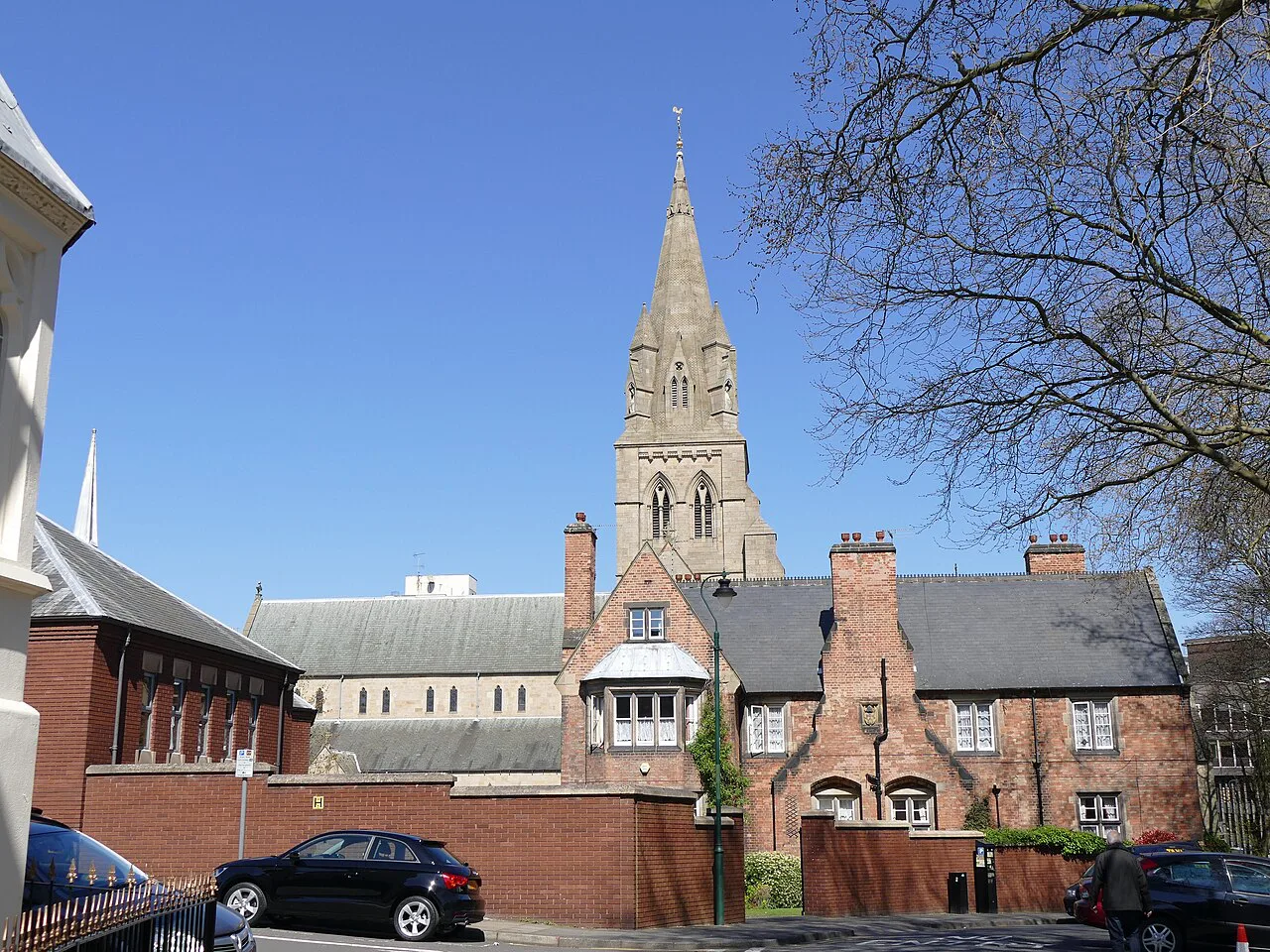
From the street the first thing to find is the crossing tower with its pointed spire, the landmark visible above the surrounding roofline. Lancet windows and carved stonework carry the Early English Gothic look across the façade. It is worth stepping back across the junction to take in the whole composition before going in, because the proportions only make sense from a distance.
Inside: the three-aisled plan, timber roof and sculpture
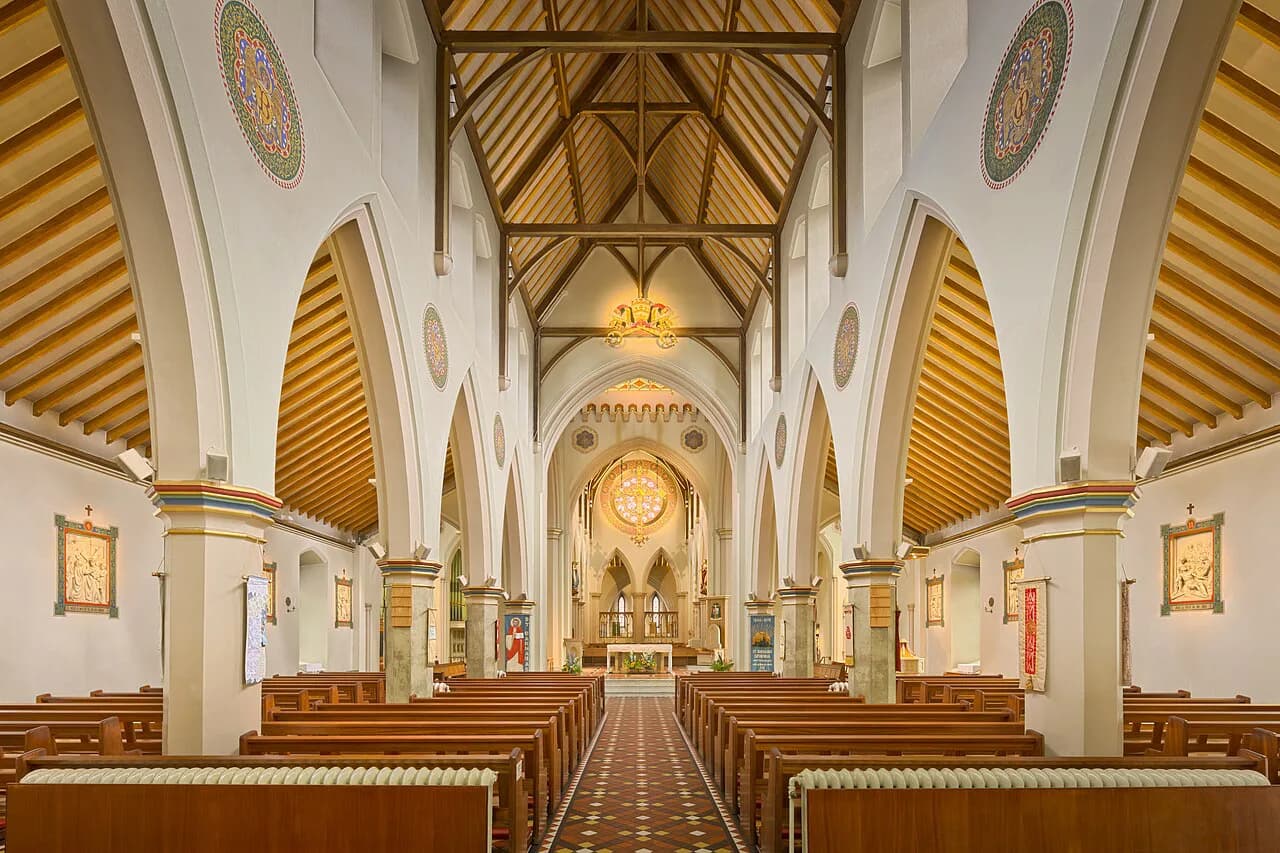
Inside, the three-aisled plan opens up under an open timber roof, with sculptures surviving from the construction period. The timber roof is the feature that most clearly carries Pugin's plain Gothic intention, so look up early rather than at the end of your walk round. The nave roundels are the other detail to seek out, since they are among the fragments of original decoration that have been uncovered and restored.
The Blessed Sacrament Chapel: Pugin's decorated contrast
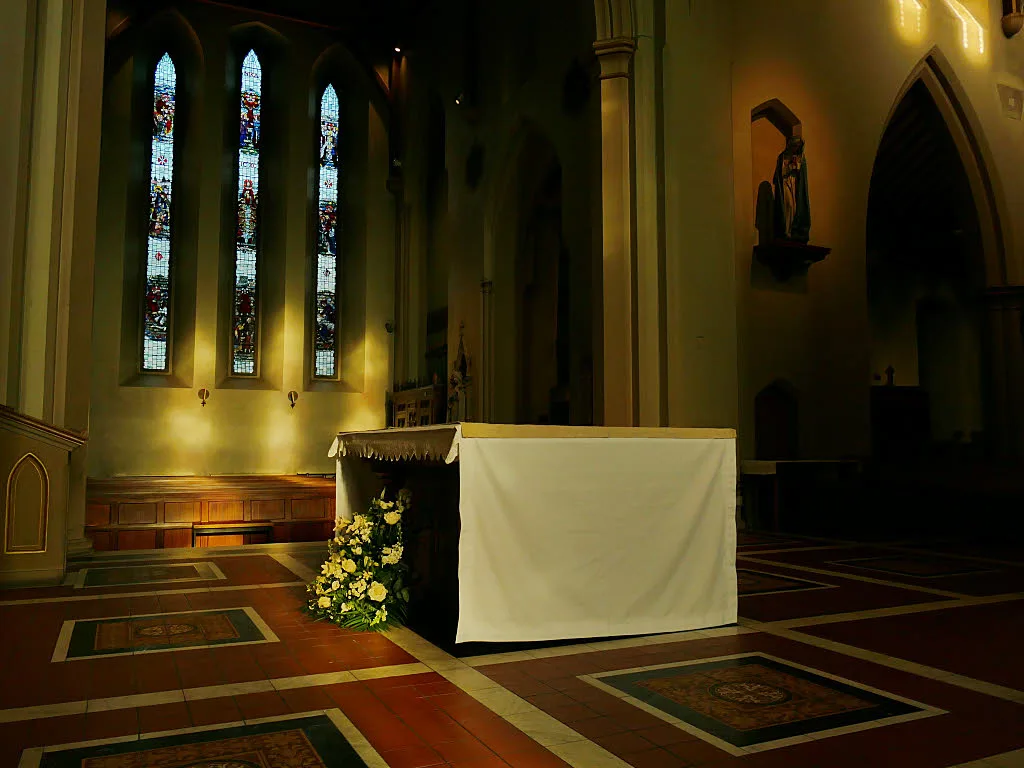
The Blessed Sacrament Chapel is the interior's richest space and the deliberate counterpoint to the plain Gothic shell, reflecting Pugin's later taste for the Decorated Gothic style. Where the nave is austere, the chapel is dense with ornament, so give it the slowest part of your visit. Weekday morning Mass is celebrated in this chapel, which tells you how central it remains to daily use.

The tomb of Venerable Mary Potter
Look for the tomb of Venerable Mary Potter, founder of the Little Company of Mary, which was designed by Smith & Roper. It is a different kind of object from the architecture around it: a piece of nineteenth and twentieth-century Catholic history rather than a Gothic set piece. Pair it with the chapel in the same sweep of the building so you are reading the cathedral as a living devotional space, not just a Pugin study.
Pugin's lost and restored decoration
Much of Pugin's original decorative scheme was lost in the renovations that followed the Second Vatican Council in the 1960s, when the old high altar was replaced and painted decoration was covered over. Knowing that in advance stops the interior feeling merely bare: the plainness is partly accident, not entirely design. The uncovered fragments, including those nave roundels, are the evidence of what once covered far more of the walls.
The Lady Chapel restoration begun in 2022
In September 2022 the cathedral began a restoration project to uncover and restore some of Pugin's original designs, with a grant from the National Lottery Heritage Fund and work involving Nottingham Cathedral, Nottingham Trent University and Culture Syndicates. The focus is the Lady Chapel, where whitewash is being carefully removed to reveal the decoration beneath. The project is ongoing, so treat the Lady Chapel as a work in progress and look closely at the walls rather than walking straight through.
Music at the cathedral
Music is embedded in the cathedral's life: choral scholarships draw singers from the Nottingham area, and the building has had a succession of Directors of Music. The choir performs a repertoire of sacred music, and the building's acoustic does much of the work. If music is the reason for your visit, check the cathedral's own what's-on pages for services and events before you travel rather than relying on a fixed expectation.

Tickets, opening hours and Mass times
The cathedral lists a recurring weekday Mass at 7.30am, Tuesday to Friday, held in the Blessed Sacrament Chapel. That single page is not the full pattern of services, so use the cathedral's own services and what's-on listings to confirm the day you plan to visit. Sightseeing around a service is fine, but arriving mid-Mass and treating the chapel as a photo stop is not.
The cathedral publishes its contact details on its own site: telephone 0115 953 9839, an email contact, and the postal address at North Circus Street, NG1 5AE. Use those to ask directly about visiting outside service times.
How long to allow and how to get there
Allow about an hour for the cathedral itself: fifteen minutes for the exterior and spire, half an hour inside moving between nave, Blessed Sacrament Chapel, Mary Potter's tomb and the Lady Chapel, and the rest for sitting still. Add time if you want to read the restoration interpretation properly.
North Circus Street sits just off Derby Road on the western edge of the centre, within walking distance of the main shopping streets and the Castle. Coming from the station or the Market Square area, it is a straightforward walk rather than a bus trip, and combining it with a Castle visit makes a coherent half day.
Nearby: what to pair with the cathedral
The cathedral is convenient for several other stops. Wollaton Hall, the Elizabethan prodigy house in Wollaton Park, needs its own trip and more time, so do not try to bolt it onto a cathedral morning.
Closer in, Nottingham Contemporary at Weekday Cross is the obvious contemporary art stop, and the National Ice Centre and Nottingham Playhouse cover evening entertainment. St Mary's Church in the Lace Market gives you a contrasting Anglican medieval building if you want to compare church architecture across the city. For a Catholic counterpart in another city, Birmingham Cathedral (St Philip's) makes a similarly compact city-centre stop with its own story and setting.
Plan Your Visit
Nottingham Cathedral is best approached as a Pugin building with a complicated afterlife: plain Early English Gothic outside and through the nave, richly decorated in the Blessed Sacrament Chapel, and partly stripped by 1960s changes elsewhere. The Lady Chapel restoration gives you a reason to look at the walls rather than walk past them. Check the cathedral's own service listings before you set out, then give it an hour and walk on to the Castle.
Explore more Nottingham guides
Frequently Asked Questions
Is Nottingham Cathedral Catholic?
Yes. The Cathedral Church of St Barnabas is the Catholic cathedral for the Diocese of Nottingham and the seat of the Bishop of Nottingham. It was raised to cathedral status in 1852, shortly after the Catholic hierarchy was restored in England and Wales.
Who designed Nottingham Cathedral?
Augustus Welby Northmore Pugin, the architect also known for his work on the interior of the Houses of Parliament. He designed St Barnabas in the Early English Plain Gothic style, with the richly decorated Blessed Sacrament Chapel showing his later preference for the Decorated Gothic.
When was Nottingham Cathedral built?
The church was built between 1841 and 1844 and consecrated in 1844, with funding from Lord Shrewsbury. It was one of the first four Catholic cathedrals in the country since the Reformation, elevated in 1852.
Where is Nottingham Cathedral?
At the junction of Derby Road and North Circus Street in Nottingham city centre, postcode NG1 5AE. It is a walkable stop from the main shopping streets and close to Nottingham Castle.
What can you see inside Nottingham Cathedral?
The three-aisled nave under an open timber roof, the Blessed Sacrament Chapel with its dense decoration, the tomb of Venerable Mary Potter by Smith & Roper, and the surviving fragments of Pugin's original painted scheme, including the nave roundels. The Lady Chapel restoration, begun in 2022, is uncovering more.
How long does it take to visit Nottingham Cathedral?
About an hour covers the exterior, nave, Blessed Sacrament Chapel, Mary Potter's tomb and the Lady Chapel comfortably. Allow longer if you want to read the restoration interpretation or sit quietly.
Is Nottingham Cathedral free to visit?
The cathedral does not publish a visitor admission charge on its own site, so ask directly using the contact details it lists before planning around a ticket. It is a working church, so visits fit around services.
When are services at Nottingham Cathedral?
A recurring weekday Mass is listed at 7.30am, Tuesday to Friday, in the Blessed Sacrament Chapel. That is not the complete pattern of services, so confirm the day you plan to visit through the cathedral's own services and what's-on listings.