
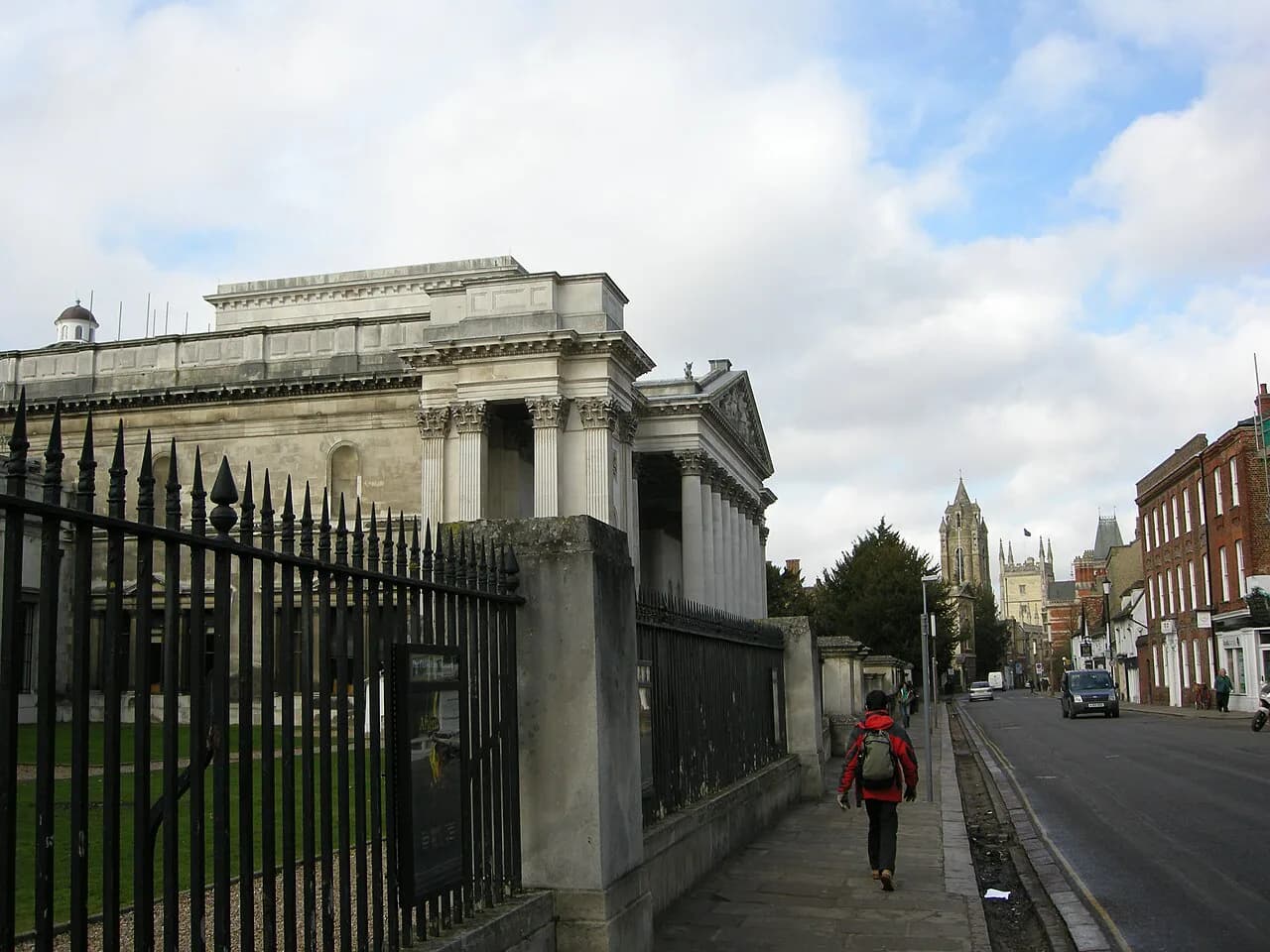
Fitzwilliam Museum: A Visitor's Guide to Cambridge's University Art Museum

The Fitzwilliam Museum is the University of Cambridge's art and antiquities museum on Trumpington Street, and entry to the permanent collection costs nothing. It opens Tuesday to Saturday from 10am to 5pm, Sunday and Bank Holidays from 12pm to 5pm, and stays closed on Mondays.
With more than half a million objects, it suits anyone who wants Egyptian coffins, Impressionist paintings, illuminated manuscripts and Renaissance sculpture under one roof rather than a single-subject collection. Allow at least two hours, and a good deal more if a temporary display catches your eye.
What the Fitzwilliam Museum is
The museum holds the University's collections of art and antiquities, ranging from ancient Egyptian material to modern and contemporary work. Its displays change regularly, so a return visit rarely looks identical to the last one.
It is one of the University of Cambridge Museums, a group clustered within walking distance of each other in the city centre. That makes it easy to pair with a science or archaeology collection on the same afternoon, though trying to cover three in a day usually means rushing the Fitzwilliam. If you would rather slow the trip down over several days, the Cambridge Neighborhoods guide helps you pick a base near the museum cluster.
The museum was shortlisted for Art Fund Museum of the Year 2026, the prize run by the art charity Art Fund. A shortlist place is not a win, but it signals the scale of the collection and exhibition programme.
Where it is and how to get there
The address is Trumpington Street, Cambridge CB2 1RB, on the main street running south from the city centre towards Fen Causeway. The published telephone number is +44 (0)1223 332 900.
On foot it is a straightforward walk from the central colleges and Market Square, and the other University museums sit within easy reach, so most visitors arrive without needing a bus. Drivers are pointed towards the city's Park & Ride services rather than trying to park in the centre, where spaces are scarce.
If you are building a day around the city centre, this museum slots naturally into a wider look at the [Cambridge](/attractions/cambridge) sights, and the [Cambridge Attractions: 8 Visitor Guides](/attractions/cambridge) collection covers the rest of the cluster.
Opening hours
The museum is closed on Mondays, opens Tuesday to Saturday from 10am to 5pm, and opens later on Sunday and Bank Holidays at 12pm, closing at 5pm. The Monday closure and the midday Sunday start are the two details most likely to derail a day trip, so plan the rest of your itinerary around them rather than the other way round.
A Sunday morning in Cambridge is best spent outdoors before the doors open; [The Backs, Cambridge](/attractions/cambridge/the-backs-cambridge) along the river makes an easy pre-lunch walk within reach of Trumpington Street.
Tickets and entry
Entry to the museum is free, and the current temporary displays are listed as free entry too. That covers the permanent galleries and the displays running through late 2026 and early 2027.
Special exhibitions and events can work differently, so check the museum's own What's On pages for any booking requirement before you travel. The website carries separate ticketing contact details for anything that needs reserving.
The museum also takes donations and runs a pay-what-you-can option for supporters, which is worth knowing if you want to contribute without buying a ticket.

What to see: highlights by gallery
The University's own listing names specific works by gallery, which is the most reliable way to plan a route. Among them are Monet's Les Peupliers of 1891 in Gallery 5 and Titian's Tarquin and Lucretia, painted around 1571, in Gallery 7.
Rembrandt's Portrait of a man in military costume from 1650 hangs in Gallery 15, while Nakhtefmut's mummy case is in Gallery 19 and German armour dating from around 1550 to 1610 occupies Gallery 31. Working through these five stops gives a coherent cross-section of the collection without wandering aimlessly.
Beyond the named highlights, the collection runs from Egyptian coffins and rare coins to Asian arts and Impressionist masterpieces, so the quieter upper galleries reward anyone with time to spare.
Temporary exhibitions and displays
Frank Bowling: Seeking the Sublime runs until 17 January 2027, showing the colour-driven work of the contemporary British painter, and it is free to visit. A Mughal Songbook: Art, Music and Empire stays until 7 March 2027 and explores song, poetry and performance in Mughal South Asia between roughly 1750 and 1850.
An Enamel Revolution: China and the World closes on 21 February 2027 and looks at how enamel decoration developed in China from the 1600s through art, technology and trade. All three are temporary displays with free entry, so they can be added to a visit without a separate ticket.
Looking further ahead, A Call to Art: William Morris and the Pre-Raphaelites is scheduled from 23 October 2026 to 3 May 2027. Treat all of these dates as scheduled rather than guaranteed and confirm before booking travel around a specific show.
How long to allow and when to go
Two hours covers the headline galleries and one temporary display at a comfortable pace; three to four hours lets you take in the ceramics, coins and manuscripts as well. The museum is busiest at weekends and during university terms, so a Tuesday to Friday morning arrival after 10am generally gives the calmest run at the galleries.
Because the museum is closed on Mondays and opens at noon on Sundays, Saturday is the only weekend day with a full morning. If your trip is short, put the Fitzwilliam first and leave the colleges for the afternoon.
Accessibility and facilities
Visitors with restricted mobility should use the Courtyard Entrance, which is at street level and close to a lift serving all floors. Most areas have flat or slightly sloping floors, seating is available throughout, and wheelchairs can be borrowed at that entrance.
Large print information is available in the galleries, and large print, Braille and tactile versions of signage and the museum map are stocked at both entrances. Induction loops are fitted at both entrances, with portable loops for talks and events bookable in advance.
A café and shop sit within the museum, and the nearest Changing Places toilet is in the Grand Arcade car park rather than on site. Disabled badge-holders can park on Trumpington Street pay and display bays without a time limit, or on single and double yellow lines for up to three hours where no loading restriction applies.

What's nearby
The other University museums are within walking distance, and the [Museum of Archaeology and Anthropology](/attractions/cambridge/museum-of-archaeology-and-anthropology) makes a logical second stop if you want more on early human history. The city's churches are close too: [Great St Mary's](/attractions/cambridge/great-st-marys) sits by the market and the [Round Church](/attractions/cambridge/round-church-cambridge), properly the Church of the Holy Sepulchre, is a short walk north. If you plan to explore beyond the museum cluster, the [Cambridge Neighborhoods](/neighborhoods/cambridge) guide maps the surrounding areas.
For a different pace, the [Mathematical Bridge](/attractions/cambridge/mathematical-bridge) at Queens' College and the [Cambridge University Botanic Garden](/attractions/cambridge/cambridge-university-botanic-garden) both sit within a reasonable walk south of the museum.
If you are extending the trip beyond the city, [Wimpole Hall](/attractions/cambridge/wimpole-hall), a National Trust property, makes a half-day outing by car, and our guide to [things to do in Cambridge](/things-to-do-in-cambridge) covers the rest of the centre.
Practical tips before you go
Check the museum's What's On page for any exhibition that requires booking, and confirm opening hours before travelling, as these are the only two details that can change a plan at short notice.
Bring a light bag, since the galleries are spread over several floors and the lifts are busiest at opening time; arriving at 10am on a weekday gives you the clearest run at the main staircases. Plan lunch either before or after rather than mid-visit if you want to see everything on your list.
If you want to finish the day with [afternoon tea in Cambridge](/afternoon-tea-in-cambridge), book a table in advance and leave the museum by mid-afternoon to make it comfortably. If you are weighing up where to stay for the evening, the [Cambridge Neighborhoods](/neighborhoods/cambridge) guide compares the areas closest to the centre.
Plan Your Visit
The Fitzwilliam Museum is free, closed on Mondays, and best visited on a weekday morning when the galleries are quiet. Build your day around the named works in Galleries 5, 7, 15, 19 and 31, then add one temporary display if time allows.
Confirm any exhibition booking and the day's opening hours on the museum site before you set out, and check the [Cambridge Neighborhoods](/neighborhoods/cambridge) guide if you are deciding where to stay.
Frequently Asked Questions
Is the Fitzwilliam Museum free to enter?
Yes. The museum lists entry as free, and its current temporary displays are also listed as free entry. Check the What's On pages for anything that needs booking.
What are the Fitzwilliam Museum's opening hours?
It is closed on Mondays. Tuesday to Saturday it opens from 10am to 5pm, and on Sundays and Bank Holidays from 12pm to 5pm.
What is the most famous painting at the Fitzwilliam Museum?
The museum does not rank its works, but the University listing names Monet's Les Peupliers (Gallery 5), Titian's Tarquin and Lucretia (Gallery 7) and a Rembrandt portrait (Gallery 15) among its highlights.
What is on at the Fitzwilliam Museum in 2026 and 2027?
Frank Bowling: Seeking the Sublime until 17 January 2027, A Mughal Songbook until 7 March 2027, An Enamel Revolution until 21 February 2027, and A Call to Art from 23 October 2026 to 3 May 2027.
How long does it take to visit the Fitzwilliam Museum?
Allow two hours for the headline galleries and one display, or three to four hours to cover the wider collection.
Where is the Fitzwilliam Museum in Cambridge?
It is on Trumpington Street, Cambridge CB2 1RB, a walk from the city centre and from the other University of Cambridge museums.
Is the Fitzwilliam Museum accessible for wheelchair users?
Yes. Use the step-free Courtyard Entrance, which has a lift to all floors and wheelchairs available for visitors to borrow.