
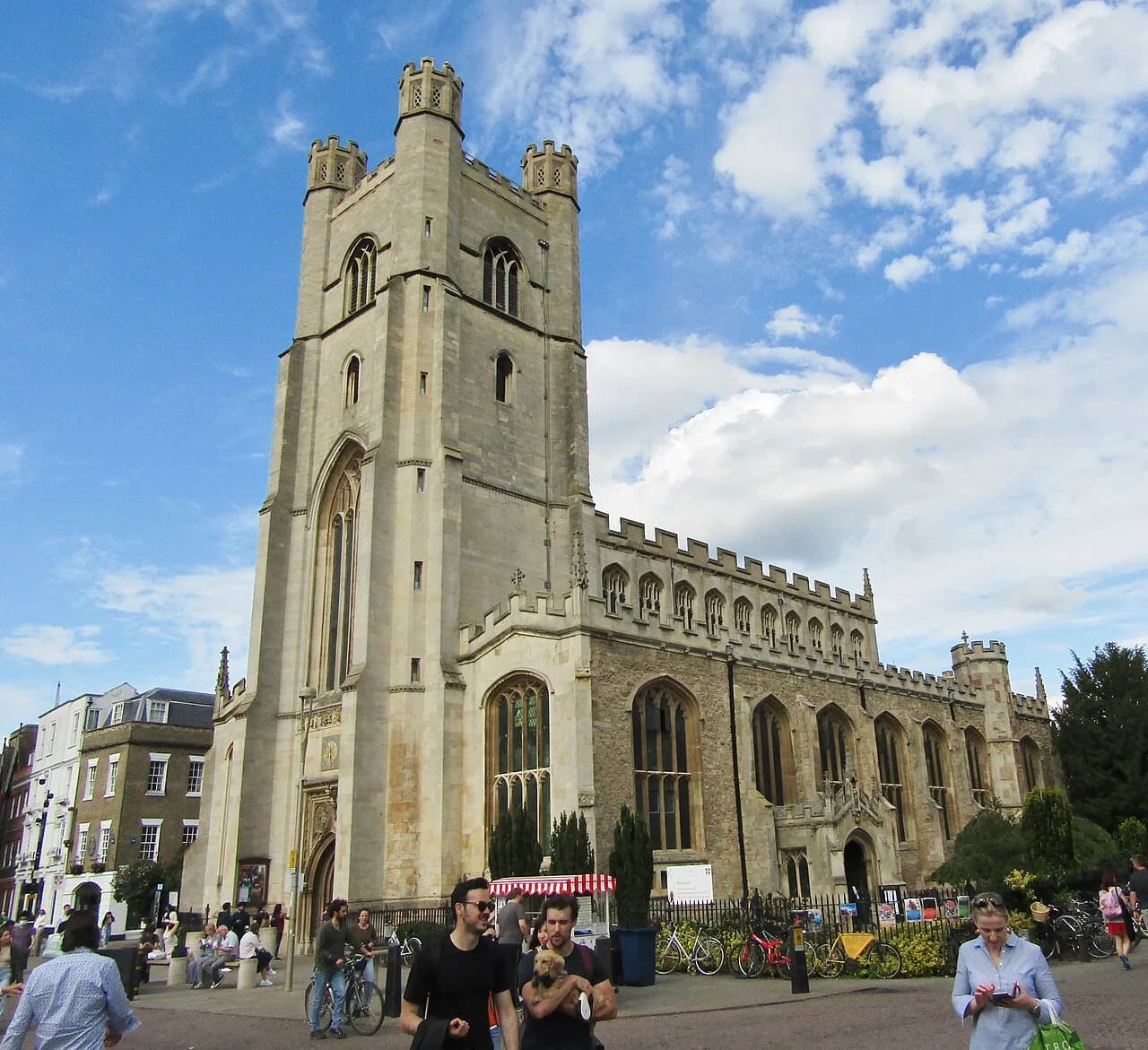
Great St Mary's, Cambridge: what to see at the University Church

Great St Mary's is Cambridge's University Church, standing on Senate House Hill opposite the Senate House and close to both King's College and Gonville Caius College. Because Cambridge has no cathedral, the church carries a cathedral-like role for the city as well as serving its parish.
It is a short stop rather than a half-day, and the reason to go in is the interior: a 1632 font, a surviving west gallery, Victorian stained glass and a gilded sculpture above the High Altar. Treat it as a working church first and a sight second, because services take priority over sightseeing.
Where Great St Mary's sits in Cambridge
The church closes the view at the end of King's Parade, on Senate House Hill by the edge of the market place. That position makes it easy to fold into a central walk: you pass it on the way between the market and the colleges along King's Parade.
Officers of the University are required to live within twenty miles of Great St Mary's, and undergraduates within three, which says something about how central the building has always been to University life. Locals shorten the name to Great St Mary's or simply GSM to distinguish it from Little St Mary's on Trumpington Street.
A short history of the University Church
The church is first mentioned in 1205, when King John presented Thomas de Chimeleye to the rectory, and the first church on the site went up that year. Four years later it became the first home of the University of Cambridge when scholars arrived from Oxford, and lectures, degrees and celebrations took place here.
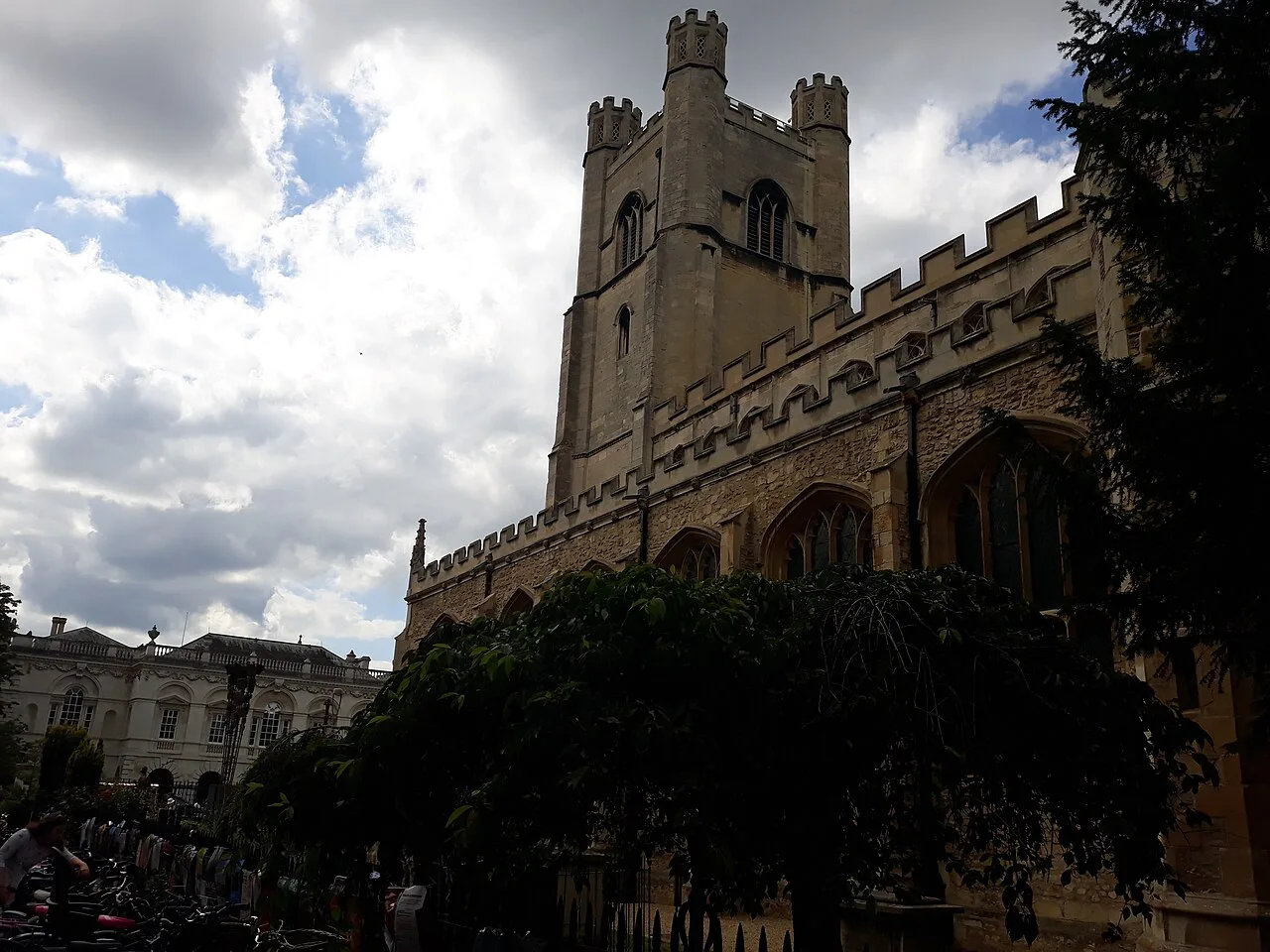
The present building was put up between 1478 and 1519, with building costs largely met by Richard III and Henry VII, and the tower was completed in 1608. The church is Grade I listed and was designed in the Late Perpendicular style.
The Reformation left its mark through preachers such as Erasmus, Thomas Cranmer, Hugh Latimer and Nicholas Ridley, and the church later became a preaching centre with galleries on all four sides for University members required to hear formal sermons. In 1732 it also became the datum point from which the first English milestones were measured, before the Senate House was built across the street in 1730.
Stephen Hawking's funeral was held here in 2018 before his ashes were interred at Westminster Abbey. Take that as history rather than an event you can attend, and expect the building to be in normal church use when you arrive.
What to see inside Great St Mary's
Start with the font, which dates from 1632, and look up at the west gallery, the one gallery left after the north and south galleries were removed in the 19th century. The east window depicting the Nativity of Christ was installed in 1869 and is the work of Chance Brothers of Birmingham, while other stained glass by Hardman was added in 1867 and 1869.
Above the High Altar hangs the Majestas Christi, a gilded wood sculpture of the Majesty of Christ made by Alan Durst in 1959 and installed the following year. Its imagery comes from the Book of Revelation, with Christ before the cross as the tree of life, the wounds of the crucifixion visible, and the four evangelists around him as lion, ox, man and eagle.
The clerestory windows reward a slower look: they were inserted between 1902 and 1904, each based on a verse of the Te Deum, and together they portray sixty figures running east to west along the north side and back along the south. Allow a few minutes to trace the sequence rather than glancing at one window and leaving.
Two organs and the Cambridge Chimes
Great St Mary's is unusual in housing two self-contained pipe organs. The University Organ sits in the west gallery and was rebuilt by William Hill in 1870, while the parish organ in the chancel was built in 1991, and the arrangement allows a double organ concerto to be performed here.
The University Clock chimes the Cambridge Quarters, the tune later used by Big Ben. The old ring of bells was replaced in 2009 with a new ring of thirteen cast by Taylors Eayre and Smith, and some of the original bells were kept to carry on sounding the chimes.

University sermons and ceremonies
Great St Mary's remains the place for University sermons and other services, and it is home to the University Organ and the University Clock. The tradition goes back a long way: in 1303 the University ordered that a special sermon be preached here four times a year, and the University Sermon continues today.
Guided walking tours of Cambridge meet inside the Round Church at 2.15pm on Wednesdays, Thursdays, Fridays and Saturdays, according to the GetYourGuide listing. If you want a structured tour of the centre rather than a self-guided look inside the church, that is the timing to plan around. Check current times before you travel.
How long to allow and when to go
Budget around twenty to thirty minutes inside for the font, the galleries, the east window, the Majestas Christi and the clerestory glass. It is a short central stop, not a museum visit, so pair it with something else rather than building a day around it.
Time your visit around services, because this is a working church and worship takes priority over sightseeing. If you arrive during a service, wait outside or come back later instead of walking round with a guidebook in hand.
Tickets, opening times and tower access
Check the church's own site for current opening hours and service times before you travel, and for any charge or rule attached to the tower. The tower was completed in 1608, but nothing here confirms that visitors can climb it, so do not plan your day around a tower ascent until the church confirms access.
Opening arrangements in Cambridge change with term dates and services, so a same-week check is worth the two minutes. If the church is closed when you arrive, the market place and King's Parade are immediately outside and worth the walk on their own.

Getting there on foot
Walk to Great St Mary's from the market square or along King's Parade; it stands at the end of the parade on Senate House Hill. From most of the historic centre this is a matter of minutes on foot, which makes it one of the easiest stops to slot into a walking route.
The railway station sits well outside the centre, so plan on a onward walk or a local bus rather than arriving at the door by train. Once in the centre, everything on this page is walkable and you will not need transport between the church and its neighbours.
What is nearby
The Senate House stands directly across the street, built in 1730, and King's College and Gonville Caius College are both close by. Trinity College, which has owned the site since 1342, is a short walk away, so the church fits naturally into a route around the central colleges. If you want to see how the colleges and the market sit within the wider city, the Cambridge Neighborhoods map out the centre and the quieter streets around it.
For a wider plan of the city, the Cambridge Attractions: 8 Visitor Guides collection covers the colleges, museums and green spaces within walking distance of the church. Two of the free heavyweight museums are the Fitzwilliam Museum on Trumpington Street and the Museum of Archaeology and Anthropology, both useful wet-weather backups after a church visit. If you would rather plan your day by area than by sight, these Cambridge Neighborhoods show how the centre, the colleges and the quieter streets fit together.
If you want a country-house afternoon, the National Trust's Wimpole Hall lies outside the city and needs its own transport. For a sit-down meal after the walking, afternoon tea in Cambridge is a sensible way to finish a central loop that begins at the church, and it pairs well with a slow wander through the Cambridge Neighborhoods if you are deciding where to stay.
Plan Your Visit
Great St Mary's is the one church in central Cambridge that explains the University rather than a single college, and it costs you half an hour between the market and King's Parade. Go for the 1632 font, the surviving west gallery, the 1869 east window and Durst's gilded Majestas Christi, and accept that services may close the building to sightseers while you are there.
Confirm the day's opening hours and service times with the church before setting out, then build the rest of your walk around the Senate House, King's and Caius.
Explore more Cambridge guides
Frequently Asked Questions
Is Great St Mary's free to visit?
The church has not published an admission charge in the information here, and no source confirms that entry is free. Check the church's own site for any charge before you go, and note that any tower access may be priced or restricted separately.
Can you climb the tower at Great St Mary's?
The tower was completed in 1608, but nothing in the available information confirms that visitors can climb it or under what conditions. Ask the church directly or check its site for tower access before planning a climb.
What is the difference between Great St Mary's and Little St Mary's in Cambridge?
They are two separate churches. Great St Mary's on Senate House Hill is the University Church, known locally as GSM, while Little St Mary's stands on Trumpington Street and is the better-known Anglo-Catholic church in the city.
Why is Great St Mary's called the University Church?
Cambridge has no cathedral, so Great St Mary's serves both as a parish church and as the University church, with a role similar to a cathedral's. It was the first home of the University when scholars arrived from Oxford in 1209, and it remains the place for University sermons.
How long do you need at Great St Mary's?
Allow twenty to thirty minutes to see the font, the west gallery, the east window, the Majestas Christi and the clerestory glass. Treat it as a short central stop and check service times, since worship takes priority over sightseeing.
Where is Great St Mary's in relation to King's College?
The church stands on Senate House Hill at the end of King's Parade, opposite the Senate House and close to both King's College and Gonville Caius College. All of these are within a few minutes' walk of each other in the historic centre.