
Mathematical Bridge, Cambridge: What to See and How to Reach It

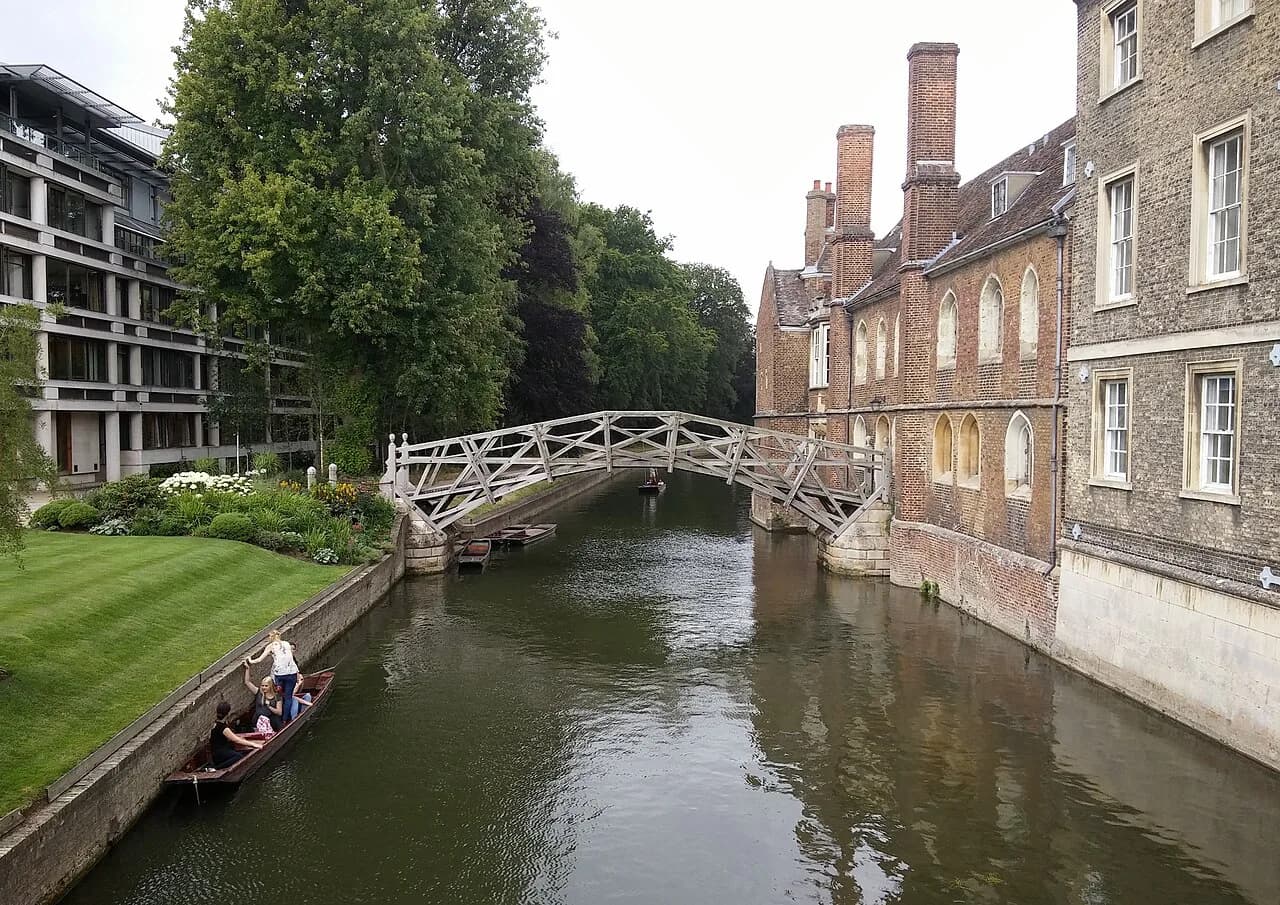
The Mathematical Bridge is a wooden footbridge over the River Cam that links two parts of Queens' College in Cambridge, and it is Grade II listed. It reads as a graceful arch, yet every timber in it is straight, which is why it draws a steady trickle of engineers, photographers and myth-spotters rather than a queue.
Treat it as a short stop of fifteen to twenty minutes rather than a long outing, best combined with the riverfront colleges and The Backs. Note that Queens' College charges a small admission fee for entry to the college and bridge, so check current terms at the porters' lodge; otherwise view it from a bank, a neighbouring bridge or the water and build it into a walk along the Cam.
Where the Mathematical Bridge Stands
The bridge crosses the River Cam about a hundred feet north-west of Silver Street Bridge, in the south-west of central Cambridge. That short distance makes it easy to find on foot from the city centre, and it sits close to the point where Silver Street meets the river.
It connects two parts of Queens' College, which owns it, so the bridge is part of a working college rather than a civic right of way. Silver Street Bridge is the handiest reference point for a map app, and the riverbank paths either side give you your first sight of the timberwork.
The Engineering: Straight Timbers in an Arch
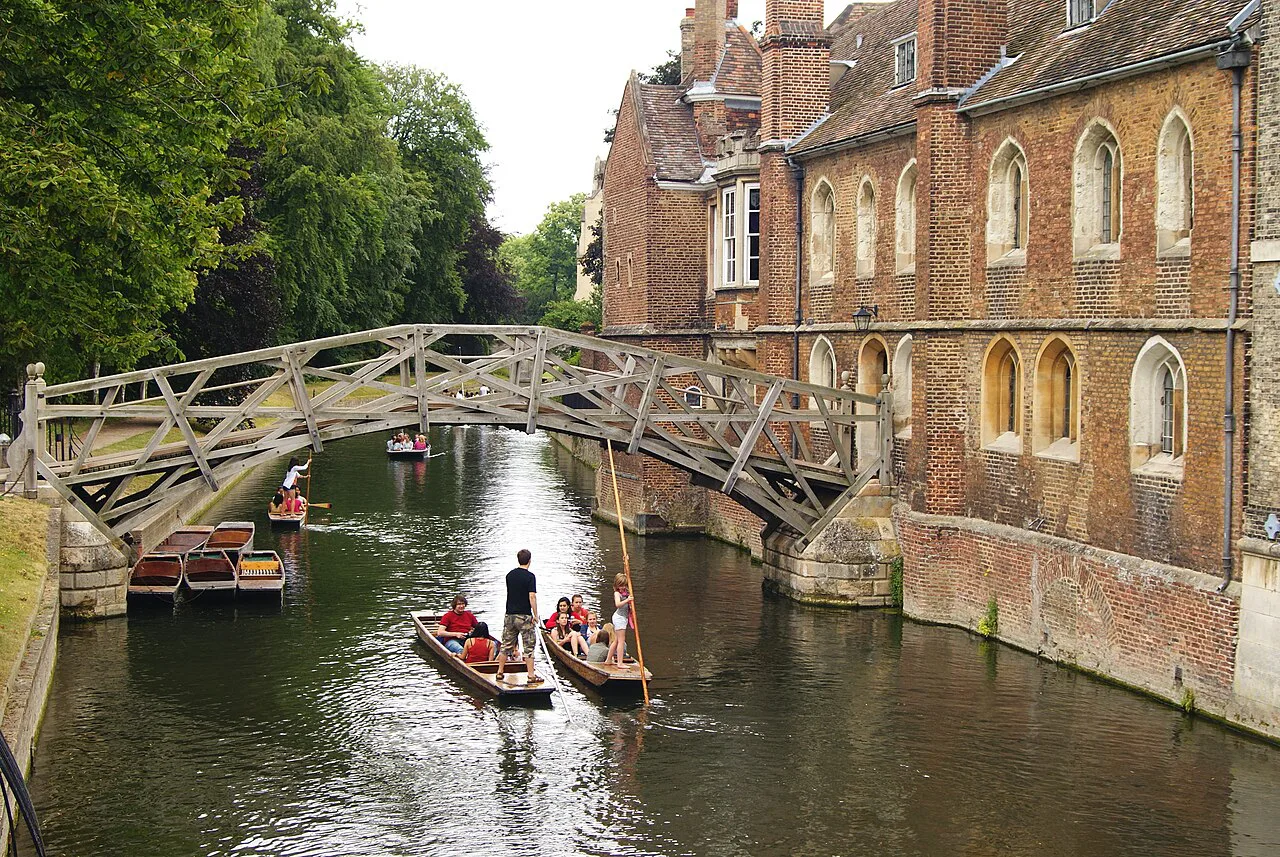
The structure uses tangent and radial trussing: a series of straight timbers set as tangents describes the arc, and radial members tie them together and triangulate the frame so it becomes rigid and self-supporting. Analysis of the design shows the tangent members sit almost entirely under compression while the radial timbers are almost entirely in tension, with very little bending stress.
That arrangement is an efficient structural use of timber, and the same technique was used for the centring that supported stone arches during construction. In plain terms, the bridge expresses the forces of an arch without being one, which is exactly the trick that makes it worth a look.
A Short History: Etheridge, Essex and Two Rebuilds
William Etheridge designed the bridge and James Essex built it in 1749, on stone abutments. It has been rebuilt twice, in 1866 and 1905, keeping the same overall design each time, so what you see today follows the original concept rather than replacing it.
An earlier model made by Etheridge in 1748 survives in the possession of Clare College, which is a useful reminder that the bridge began as an engineering idea before it was a landmark. If you are tracing Cambridge's college architecture, the bridge belongs on the same walk as the riverfront courts and bridges nearby.
The Newton Myth, Told as Legend
A popular fable holds that Sir Isaac Newton designed and built the bridge without nuts or bolts, and that students or fellows later took it apart and could not work out how to reassemble it. Treat both stories as folklore: Newton died in 1727, twenty-two years before the bridge was built, so he could not have been involved.
Bolts, or their equivalent, are an inherent part of the design, and iron spikes were originally driven into the joints from the outer side where they were hidden from the inner parapets. That hidden fixing explains why people assumed bolts had been added later. Repeat the tale as a tale, and the dates do the correcting for you.

The Earlier Bridge Near Trinity and Trinity Hall
The original Mathematical Bridge was a different bridge of the same design, also commissioned by James Essex, spanning the Cam between Trinity and Trinity Hall colleges. Garret Hostel Bridge now stands where that earlier crossing was, so the design has a second site in the city worth knowing about.
A replica was built in 1923 near Iffley Lock in Oxford, which is how the design travelled beyond Cambridge. On a Cambridge visit, Garret Hostel Bridge is the spot to mention if you want to explain that the Queens' bridge is the survivor, not the first of its kind.
Views and Photography
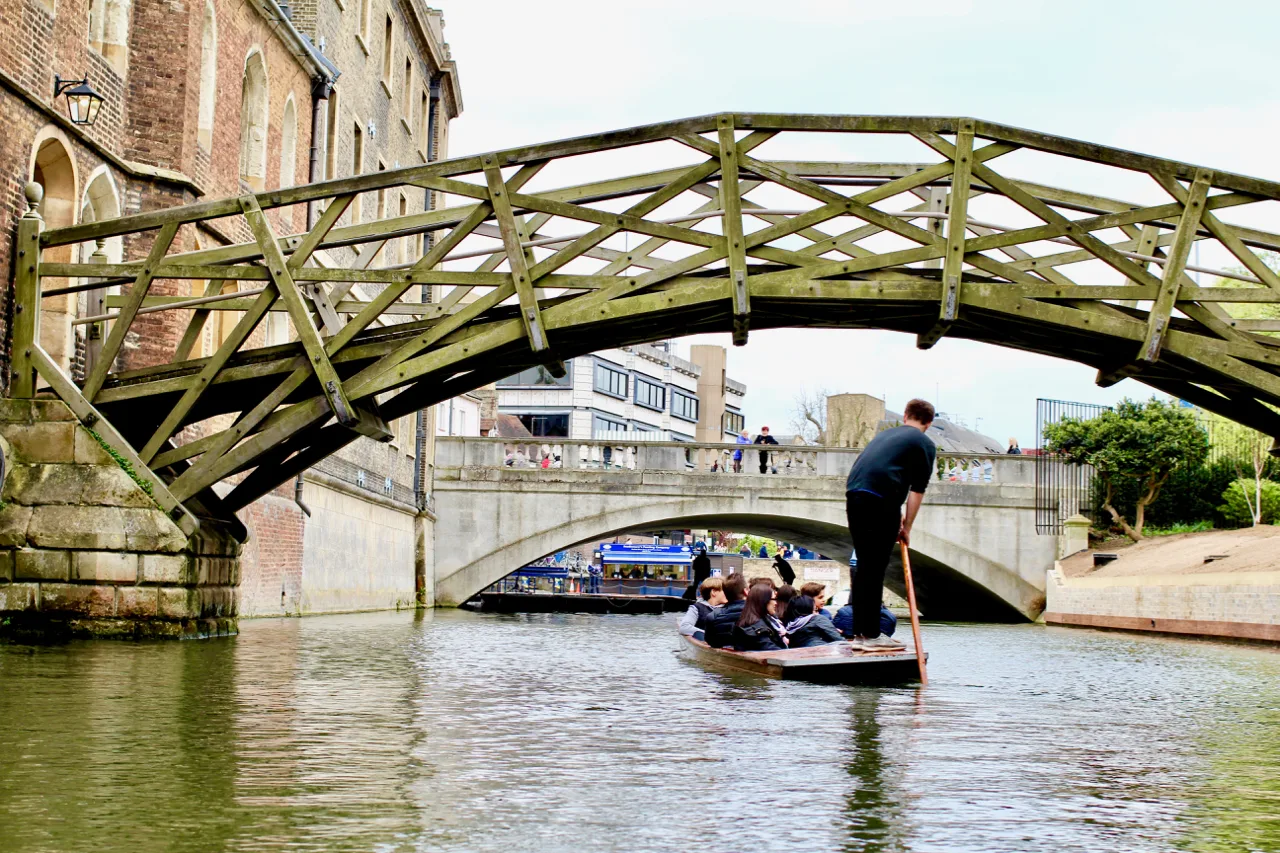
The best-known view is from a punt on the Cam, and guided and self-hire punts run from the city centre riverfront. Book or turn up according to each punting company's own published details; ticket terms and departure points change with the season, so check a company's page before you rely on a particular departure.
On foot, the riverbank and the neighbouring bridge give you a side-on look at the timber pattern, which is where the straight-timber trick reads most clearly. Morning light flatters the south face, and the bridge is small enough that a wide shot benefits from including the college buildings behind it.

Getting There and How Long to Allow
Walk from the city centre down Silver Street to the river; the bridge is roughly a hundred feet north-west of Silver Street Bridge, a few minutes on foot from the shops and colleges around the market. Cambridge is compact, and this stretch of the Cam is an easy addition to a walking day rather than a separate trip, which makes it simple to pair with the areas set out in Cambridge Neighborhoods.
Allow fifteen to twenty minutes at the bridge itself, longer if you are punting or photographing from several angles. Access to the bridge depends on Queens' College, so ask at the college before planning to walk across it rather than viewing from the bank.
Nearby: Colleges, the River and the Rest of Cambridge
Queens' College, Silver Street Bridge and the riverfront colleges sit within a few minutes' walk, and The Backs gives you the long view of college lawns and bridges that most visitors come for. If you want the wider set of options, our Cambridge Attractions covers the museums, colleges and historic houses worth your time. When you are weighing up where to base yourself for this stretch of the river, Cambridge Neighborhoods sets out the areas around the colleges. If you would rather round off the walk indoors, our guide to afternoon tea in Cambridge covers where to book and what it costs.
The Fitzwilliam Museum, Cambridge is a short walk south-east for a free dose of art and antiquities, and it pairs well with a riverfront wander when the weather turns. For a country-house day out, the National Trust's Wimpole Hall lies outside the city and needs its own half-day.
Plan Your Visit
The Mathematical Bridge is a fifteen-minute stop with a genuinely interesting engineering story and a myth worth retelling correctly. Build it into a river walk or a punt trip, view it from the bank or the water, and check with Queens' College before planning to cross it.
Explore more Cambridge guides
Frequently Asked Questions
Was the Mathematical Bridge really built by Isaac Newton?
No. William Etheridge designed it and James Essex built it in 1749, while Newton died in 1727, twenty-two years before construction. The Newton story is a popular fable, and so is the tale that students dismantled the bridge and could not rebuild it.
Why is the Mathematical Bridge called that?
It takes its name from its geometry. The bridge looks like an arch but is built entirely from straight timbers arranged as tangents with radial members, a technique called tangent and radial trussing that distributes compression and tension efficiently.
Can you walk across the Mathematical Bridge?
The bridge connects two parts of Queens' College and the college owns it. Expect to view it from the riverbank or a neighbouring bridge rather than crossing. Check current access details with Queens' College.
Where is the best place to view the Mathematical Bridge?
The classic view is from a punt on the River Cam, which shows the timber pattern side-on. On foot, the riverbank and the area around Silver Street Bridge give clear angles, and the bridge sits about a hundred feet north-west of Silver Street Bridge.
How long do you need at the Mathematical Bridge?
Fifteen to twenty minutes covers a good look and a few photographs from the bank. Add time if you are punting, and allow longer if you are combining it with the riverfront colleges and The Backs nearby.
Is the Mathematical Bridge free to see?
The bridge is a Grade II listed structure owned by Queens' College and is normally viewed from public riverbank paths without a ticket. Access onto the bridge itself is a separate question for the college, and any punting trip is ticketed by its operator.
What is nearby the Mathematical Bridge?
Queens' College, Silver Street Bridge and the riverfront colleges are all within a few minutes' walk. The Fitzwilliam Museum, Cambridge is a short walk away, and the long college views along The Backs make an easy continuation of the walk.