
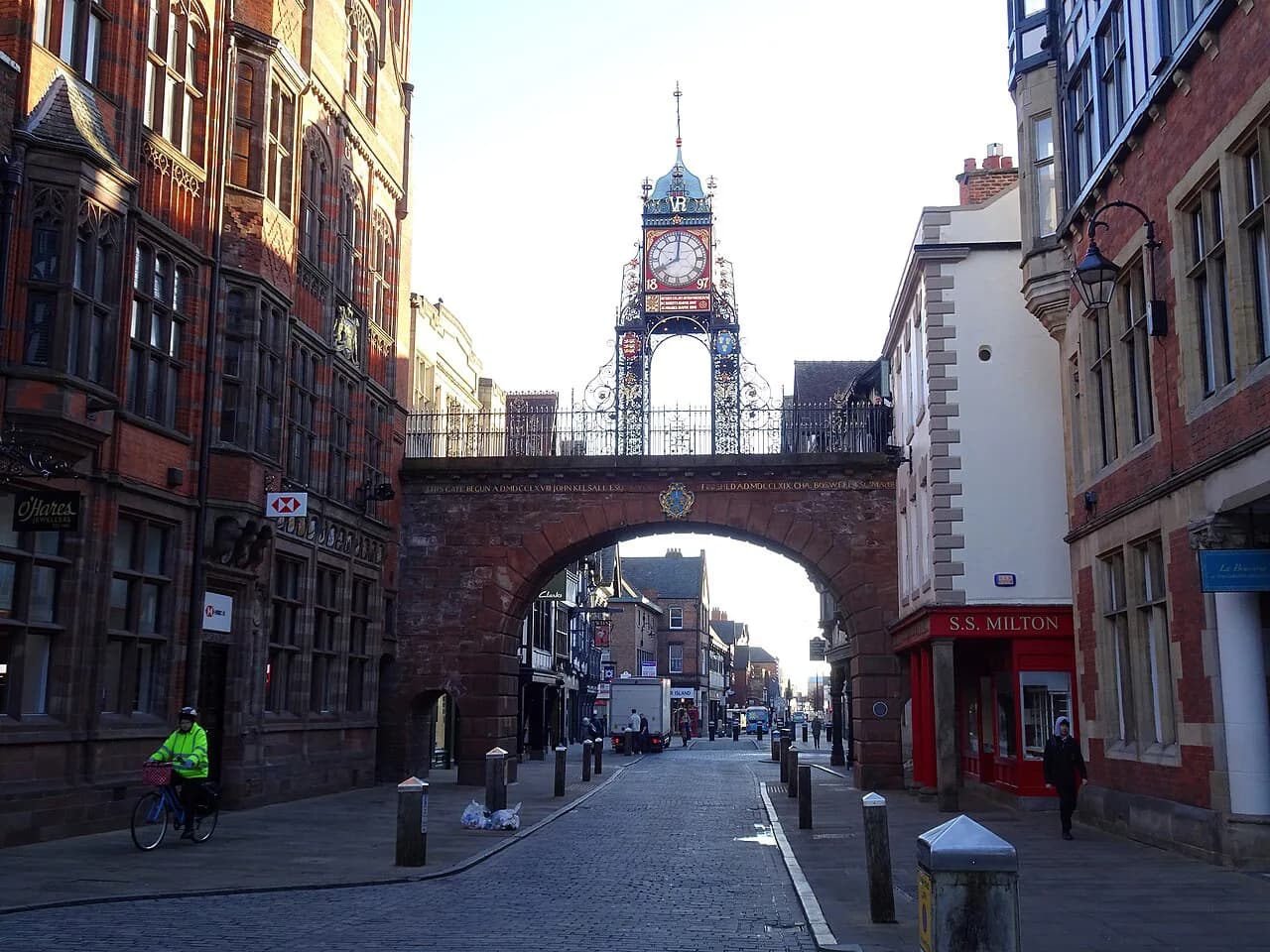
Eastgate Clock, Chester: A Visitor's Guide to the City's Landmark

Eastgate Clock is the ornate clock on top of Chester's Eastgate, the sandstone gateway that lifts the city walls walkway over Eastgate Street in the middle of the shopping centre. You cannot go inside it, there is nothing to book, and seeing it takes minutes rather than hours, so treat it as a stop on a walls circuit rather than a destination in its own right.
The clock matters because two different centuries sit in one structure: a Georgian gate built for coach traffic and a Victorian Jubilee clock added above it, on a site that was the Roman entrance to the fort of Deva Victrix. This guide separates those layers, explains how to reach the gate on foot and sets out what to pair it with nearby.
What the Eastgate Clock is
The clock is a decorative timepiece mounted on the Eastgate, the gateway that carries Chester's wall walkway across Eastgate Street. The gateway below it is a three-arched sandstone structure, so the clock reads from street level while walkers on the walls pass directly over the top of the arch. There is no tower to climb and no exhibition inside, which is why the whole visit is an outdoor viewing stop.
Chester BID describes the gateway as the original entrance to the Roman fortress of Deva Victrix, and says the present three-arched sandstone gateway dates from 1768, carrying the walkway that forms part of the city walls. It also records that the gateway and clock together were designated a Grade I listed building on 28 July 1955, which puts the structure among the most protected historic buildings in the country rather than in the curiosity category.
Where the Eastgate Clock stands
The clock stands on Eastgate Street at the point where the street crosses the line of the walls, with the postcode given as CH1 1LE. It sits in the retail heart of the centre, so you are likely to pass it while shopping on the Rows rather than making a special trip out of town. Because it is outdoors on a public street, the clock has no admission charge and no set opening hours; the city listing counts it as a free-entry landmark with great views, open around the clock.
How to get there on foot
Walking is the natural way to arrive. From the Rows and the main shopping streets, head for Eastgate Street and you will see the arch and clock ahead; the approach brings you under the gateway itself rather than beside it. If you are already walking the walls, the route crosses straight over the top of the Eastgate, which gives you the closest look at the clock and a view down Eastgate Street.
Chester BID puts the walls circuit at about two miles, first built by the Romans nearly 2,000 years ago and completed as a full circuit under the Normans in the 12th century. Doing the whole loop takes a leisurely half-day with stops; if you only want the clock, join the walls at the Eastgate and walk a short stretch either side. The city centre is compact, and most central hotels and the railway station approach bring you within a walk of Eastgate Street.
The gateway's history: from Roman fort to Georgian arch
The site is far older than the stone you see. It was the entrance to the Roman fort of Deva Victrix, and the gateway was rebuilt in Georgian times to let coaches through, which is why the present structure is a wide three-arched opening rather than a narrow medieval gate. Reading the gate as three layers, Roman site, Georgian rebuild and Victorian clock, is the most useful way to understand it.
The Roman layer is easier to picture if you follow it up elsewhere in the city. The Deva Roman Experience Chester reconstructs the fortress and its streets, and the Grosvenor Museum Chester holds Roman stonework from the legionary fortress, both within walking distance of Eastgate Street.
Chester's walls themselves are the best surviving expression of that Roman foundation, and the stretch near the Eastgate is one of the busiest. If you want the whole picture, including the towers and the later additions, an afternoon on the walls circuit explains more than any single gate can.
The clock itself: Queen Victoria's Jubilee
The clock was added to celebrate Queen Victoria's Diamond Jubilee, and it was designed by the Chester architect John Douglas, whose work shapes much of the city's Victorian architecture. Chester BID says the clock was added in 1899 to mark the Jubilee two years earlier, while the city's own listing dates the addition to 1897, so expect to see either year in print; the safe formulation is that the clock commemorates the 1897 Diamond Jubilee.
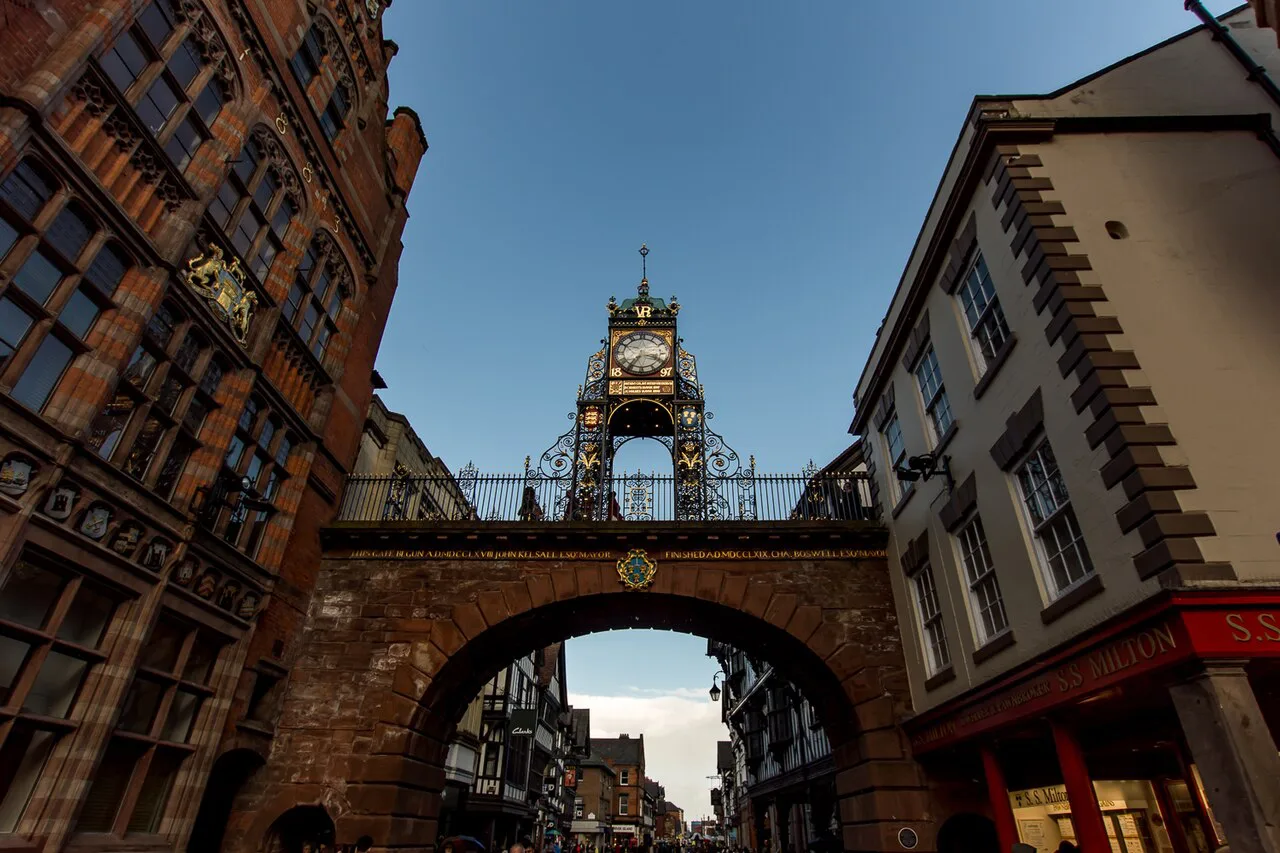
Look for the ornamental ironwork above the clock face and the way the timepiece is framed against the sky at the top of the arch. The design is decorative rather than monumental, which is part of its charm, and it reads best from the pavement slightly to the side of the arch rather than directly underneath.

The 'second most photographed clock' claim
You will often hear that the Eastgate Clock is the second most photographed clock in the UK after Big Ben. Chester.com states this directly, describing it as one of Chester's most famous landmarks and the second most photographed clock in the UK after Big Ben, and the claim is repeated widely in city material. Treat it as a local saying rather than a measured statistic, since no photography count backs it up, but it captures how central the clock is to Chester's image.
What to see at the Eastgate
From street level, the three arches give you the clearest sense of the gate as a piece of engineering: the central opening for traffic and the flanking arches for pedestrians, all cut through sandstone. Step back towards the Rows to take in the whole composition of gate and clock together, and look up at the wall walkway to see how the parapet runs straight over the top.
From the wall walkway, the view changes entirely: you look down Eastgate Street with its shopfronts and timbered upper storeys, and you get close to the clock itself. This is the better angle for understanding how the gate fits into the circuit of the walls, and it costs nothing to walk.
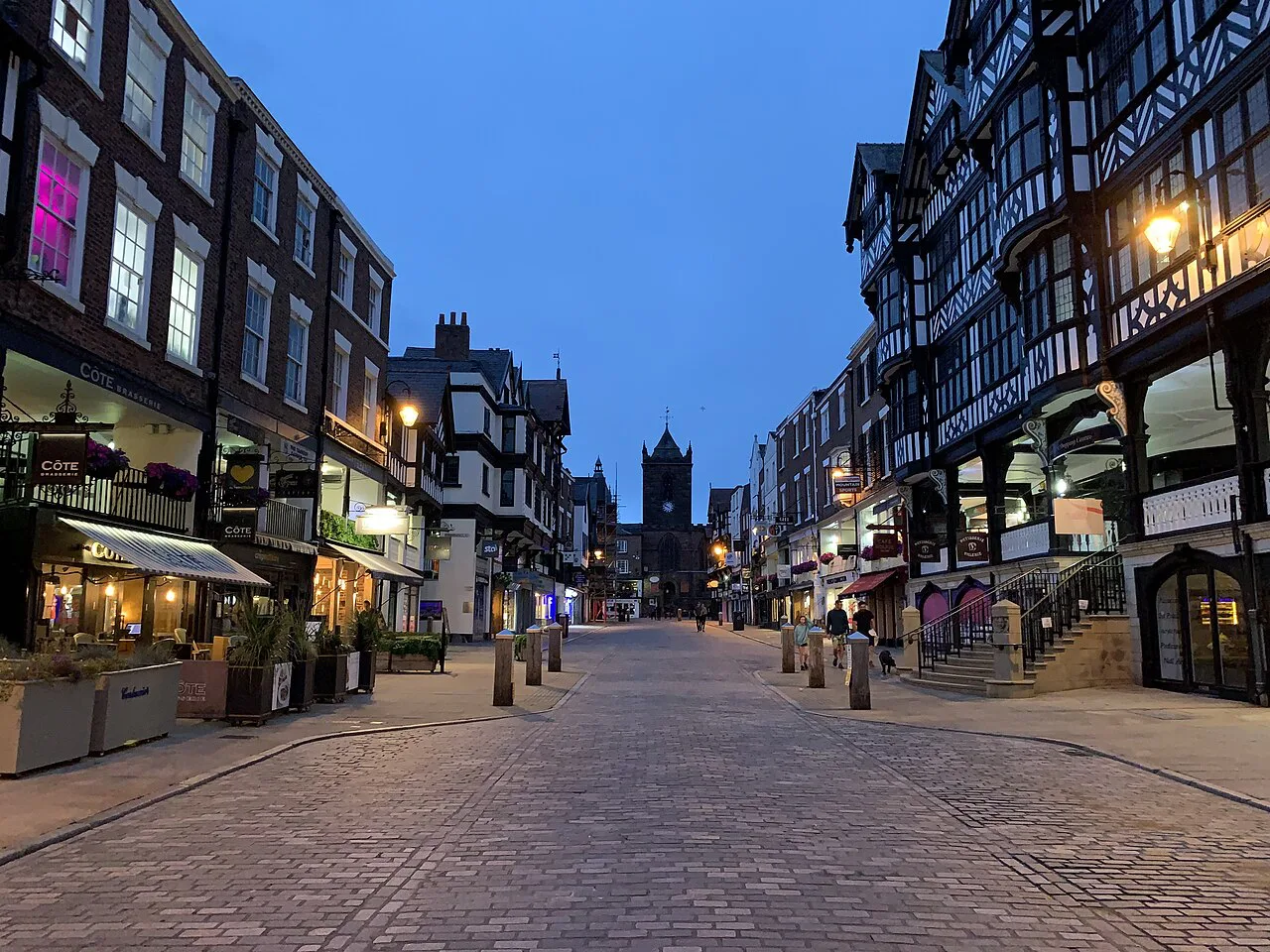
The Rows themselves are worth a detour while you are here. Chester BID describes them as continuous half-timbered galleries unique to Chester, with parts forming second and even third floors above ground-level businesses, and notes original 13th-century buildings including the Three Old Arches in Bridge Street. Walking up the steps onto the Rows gives you a raised view back towards the Eastgate.
How long you need
Allow ten to fifteen minutes at the gate itself: long enough to look at the arches from both the street and the wall walkway, read the clock and take a photograph. If you add a short stretch of the walls in either direction, budget 30 to 45 minutes. The full two-mile circuit, with stops at the towers and the cathedral, fills half a day.
The trade-off is that there is nothing to go inside, so it cannot fill a rainy afternoon. Build it into a walk between the Rows, the cathedral and the river rather than making it the reason for the trip, and you will get far more out of the centre. If the idea of lingering over a pot of tea sounds like the better way to spend the afternoon, our guide to afternoon tea in Chester covers where to go and what it costs.

Nearby: cathedral, walls and river
Chester Cathedral is a few minutes' walk away on St Werburgh Street, and its history as a Benedictine abbey turned Church of England cathedral makes it the natural next stop after the gate. Combine the two with the wall walkway and you have the core of the historic centre in a single loop.
The walls continue to the river at the Groves, a paved promenade that Chester BID describes as having a bandstand, cafés, restaurants and public houses, and where you can hire a motorboat, rowing boat or pedalo. From there the path runs on towards Chester Racecourse on the Roodee, the city's racecourse beside the river, which hosts fixtures through the season.
If you want to extend the Roman thread, the Chester Roman Amphitheatre sits just outside the walls near Vicars Lane, and Chester Castle stands at the south-west corner of the circuit with its Agricola Tower and St Mary de Castro chapel. Both are within a fifteen-minute walk of the Eastgate and reward anyone with an interest in the city's earlier layers.
For a slower afternoon, the neighbourhoods around the centre repay wandering, and the tea rooms and hotels in the city make a natural finish to a walls walk. If you would rather settle into a proper sit-down tea, our guide to afternoon tea in Chester lists where to book and what it costs. Our Chester Neighborhoods guide breaks the city down area by area if you want to plan that wander.
Who the Eastgate Clock suits
The clock suits anyone walking the walls, photographers chasing Chester's best-known image, and visitors tracing the city's Roman and Victorian layers in one place. It also suits families and budget-conscious travellers, because there is no ticket and no queue.
It does not suit anyone looking for a museum, a guided tour or a wet-weather attraction. Chester's indoor options, including the cathedral and the Grosvenor Museum, cover those needs, and the wider list of things to do shows how the gate fits into a fuller day.
What the Eastgate Clock is not
It is not a ticketed attraction. There is no entrance fee, no opening time and no closing time, because the clock stands outdoors over a public street and the walkway above it is part of the open walls circuit. Do not plan a day around it, and do not expect a visitor centre, an exhibition or a viewing platform.
What it is, instead, is a piece of street architecture that happens to carry 2,000 years of Chester's history in a single view. Give it a few minutes on your way between the Rows and the cathedral, and it earns its place.
Plan Your Visit
The most practical plan is to walk the walls through the Eastgate as part of a loop that takes in the cathedral, the Rows and the river, timing your arrival so the clock is a pause rather than a destination. Check opening times for the cathedral and any other ticketed stops the day before you travel, since those change with the season.
From the clock, the rest of central Chester is within walking distance, and a table for afternoon tea or a drink by the river makes a sensible end to a day on the walls. If you would rather book ahead, our guide to afternoon tea in Chester covers where to go and what it costs.
Frequently Asked Questions
What is the history of the Eastgate Clock in Chester?
The clock sits on the Eastgate, a three-arched sandstone gateway that Chester BID dates from 1768 and which stands on the site of the Roman entrance to the fort of Deva Victrix. The clock itself was added to commemorate Queen Victoria's Diamond Jubilee of 1897 and was designed by the Chester architect John Douglas. The gateway and clock together were made a Grade I listed building on 28 July 1955.
Is the Eastgate Clock the most photographed clock in the UK?
No, and the sayings about it usually put it second. Chester.com describes the Eastgate Clock as the second most photographed clock in the UK after Big Ben, a line repeated in city material, but it is a local claim rather than a measured statistic. Treat it as a marker of how closely the clock is tied to Chester's image rather than as a ranking.
Can you walk over the Eastgate?
Yes. The gateway carries the walkway that forms part of Chester's city walls, so anyone walking the circuit passes directly over the top of the arch and close to the clock face. That also gives you the best view down Eastgate Street. There is nothing to go inside, and the gate itself is an outdoor structure on a public street.
How long do you need at the Eastgate Clock?
Allow ten to fifteen minutes to look at the arches from street level and from the wall walkway, read the clock and take a photograph. Add 30 to 45 minutes if you walk a short stretch of the walls either side. Chester BID puts the full walls circuit at about two miles, which fills roughly half a day with stops.
Is the Eastgate Clock free to visit?
Yes. The clock stands outdoors over a public street and the walkway above it is part of the open walls circuit, so there is no ticket, no queue and no set opening or closing time. It works best as a pause on a walk between the Rows, the cathedral and the river rather than as a standalone day out.
Who designed the Eastgate Clock?
Chester BID names the Chester architect John Douglas as the designer of the clock added to the top of the gateway for Queen Victoria's Diamond Jubilee, in a city whose Victorian architecture he did much to shape. The gate beneath is much older as a site, sitting on the Roman entrance to Deva Victrix, with the present three-arched structure dating from 1768.